Guide to Cross-Border Enforcement of Civil and Commercial Judgments - South Korea Chapter
2026-10-22
(one)With which jurisdictions does this jurisdiction have reciprocal arrangements for enforcement of civil and commercial judgments?
To date, Korea has not concluded any bilateral treaty containing provisions on the recognition and enforcement of foreign judgments. Although Korea has entered into civil judicial assistance treaties with five countries, namely Australia, China, Mongolia, Uzbekistan, and Thailand, none of those treaties contains provisions concerning the recognition and enforcement of judgments. In practice, however, Korean courts have relaxed the reciprocity requirement and have broadly permitted the recognition and enforcement of foreign judgments.
(two)If there is no reciprocal arrangement, is it still possible to enforce a foreign civil and commercial judgment?
Yes. To date, Korea has not concluded any bilateral treaty containing provisions on the recognition and enforcement of foreign judgments. The recognition and enforcement of foreign judgments in Korea are primarily governed by Article 217 of the Korean Civil Procedure Act and the relevant provisions of the Korean Civil Execution Act.
Article 217(1)(iv) of the Korean Civil Procedure Act provides that, for a foreign judgment to be recognized in Korea, there must be a guarantee of reciprocity, or the requirements for recognition of foreign judgments in Korea and in the state to which the foreign court belongs must not be significantly imbalanced and must not be substantially different in material respects. A guarantee of reciprocity means that, while Korean courts recognize judgments rendered by the foreign court, that foreign state likewise recognizes Korean judgments.
In Supreme Court Decision 2002Da74213, the Supreme Court of Korea established a relaxed standard: the existence of a treaty is not required, nor is it necessary that there be a prior precedent in which the foreign state has actually recognized a Korean judgment. It is sufficient that the recognition requirements of the two states are not significantly imbalanced and are not substantially different in material respects.
In Supreme Court Decision 2009Da22952, rendered on 25 June 2009, the Supreme Court of Korea further clarified that the reciprocity requirement may be found to be satisfied where the following conditions are met: (1) there is no significant imbalance between the recognition rules applicable to judgments of the same kind in the two states; (2) the foreign state’s overall standards are not more onerous than those under the Korean Civil Procedure Act; (3) there is little substantive difference in core and material respects; (4) reciprocity does not require the conclusion of a bilateral treaty, and may be established by reference to foreign legislation, precedents, or practice; and (5) there is no need for an existing precedent in which the foreign state has recognized a Korean judgment, provided that an objectively foreseeable state of recognition exists.
Korean judicial practice has recognized that the reciprocity or substantive equivalence requirement may be satisfied in respect of the following jurisdictions, subject in each case to the type of judgment and the relevant foreign law: (1) Certain U.S. states: Minnesota, California, Hawaii, New York, Texas, Kentucky, Georgia, Washington, New Jersey, and Massachusetts; (2) Chinese Mainland and Taiwan, China; (3) Japan; (4) Ontario, Canada; (5) Russia; and (6) Germany, France, and the United Kingdom.
(three)What is the approximate time required to register and enforce a foreign civil and commercial judgment if unopposed?
Absent any service-related impediments or other objections, it generally takes approximately four to eight months from the filing of the complaint by the plaintiff to obtain a judgment of execution for a foreign court judgment at the court of first instance.
(four)What is the approximate time required to register and enforce a foreign civil and commercial judgment if opposed?
When raising objections, the defendant typically argues that the foreign court judgment at issue does not satisfy the requirements for enforcement in Korea under Korean law, including the international jurisdiction of the foreign court, whether the defendant was duly served, whether the judgment has become final and conclusive, whether the judgment is contrary to Korean public policy, and whether a reciprocal relationship exists between the relevant jurisdictions. See Articles 26 and 27 of the Civil Execution Act and Articles 217 and 217-2 of the Civil Procedure Act.
Uncontested proceedings for a judgment of execution are usually resolved within four to eight months after filing. Heavily contested cases, particularly those involving public policy challenges relating to punitive damages or disputes over jurisdiction, may take one year to eighteen months or longer. If either party is dissatisfied with the judgment of the court of first instance, it may file an appeal with the Korean High Court in accordance with the law, and, where the statutory requirements are met, may further appeal to the Supreme Court of Korea. As a result, the overall recognition and enforcement proceedings may take considerably longer.
(five)What is the approximate cost of registering and enforcing a foreign civil and commercial judgment (including court fees and other disbursements) if unopposed?
Court fees: Court fees mainly consist of stamp duties and service fees.
(1) Stamp duties: The stamp duty for an action seeking a judgment of execution is calculated by reference to the value of the subject matter of the litigation or the amount claimed. Although the general formula for calculating stamp duties in ordinary civil proceedings applies, where the action seeks only the recognition and enforcement of a foreign judgment, the stamp duty is not calculated on the full amount of the underlying claim. Instead, it is assessed by reference to a reduced value, generally calculated at approximately one-half of the value of the subject matter, in accordance with the court’s case-handling guidelines.
(2) Service fees: Service fees are calculated based on the number of parties and the number of service attempts. Based on one plaintiff and one defendant, the amount is generally calculated as: number of parties × service fee per service attempt, approximately KRW 5,640 × 15 service attempts. The total service fees are therefore typically around KRW 150,000 to KRW 200,000.
Other costs: Other costs may include Hague apostille or consular legalization fees for documents such as the foreign judgment and certificate of finality; notarization and translation fees, which may range from tens of thousands to hundreds of thousands of Korean won per page; and attorneys’ fees, which may range from several million Korean won to more than KRW 10 million, depending on the complexity of the case.
(six)What is the approximate cost of registering and enforcing a foreign civil and commercial judgment (including court fees and other disbursements) if opposed?
If the case involves service-related impediments, objections by the parties, and subsequent appeals through successive instances, the overall costs will increase significantly. However, the fees charged by the court will generally remain limited to fixed stamp duties and service fees. The main cost variations will therefore arise from service expenses and attorneys’ fees. Whether attorneys’ fees will increase as a result of objections, appeals, or additional enforcement measures depends on the specific fee arrangement and the terms of the engagement agreement.
(seven)Are there any unusual difficulties in enforcing a foreign civil and commercial judgment?
With respect to the recognition and enforcement of foreign civil and commercial judgments, Korea currently has no bilateral judicial assistance treaty specifically providing for the mutual recognition and enforcement of civil and commercial court judgments. Such matters must therefore be reviewed by Korean courts in accordance with the relevant provisions of the Korean Civil Procedure Act and the Korean Civil Execution Act.
Under Article 217(1) of the Korean Civil Procedure Act, a final and conclusive judgment rendered by a foreign court, or any adjudication having equivalent effect, may be recognized by Korean courts only if the statutory requirements are satisfied. These requirements mainly include: the international jurisdiction of the foreign court must be recognized in accordance with the principles of international jurisdiction under the laws or treaties of the Republic of Korea; the defeated defendant must have been duly served, by lawful means, with the complaint or a corresponding document, and with notice of the hearing date or order, in sufficient time to enable the defendant to defend the case, except where service was effected by public notice or by a similar method, or the defendant must have responded to the action even without such service; recognition of the final judgment or equivalent adjudication, in light of its substance and the judicial proceedings, must not be contrary to the good morals, public order, or other social order of the Republic of Korea; and there must be a guarantee of reciprocity, or the requirements for recognition of final judgments in the state to which the foreign court belongs must not be significantly imbalanced or substantially different in material respects.
Among these requirements, reciprocity is a mandatory statutory condition for the recognition of foreign civil and commercial judgments under Article 217 of the Korean Civil Procedure Act. In the absence of a treaty, the applicant will generally need to prove to the Korean court that a reciprocal relationship exists between the two states in relation to the recognition of foreign judgments, or that the recognition requirements in the two states are not substantially different in material respects. Accordingly, for a state that has no relevant treaty with Korea and for which clear judicial practice is still lacking, there is no absolute institutional barrier to the enforcement of its civil and commercial judgments in Korea. However, in the absence of a treaty and clear precedents, proving reciprocity may increase the applicant’s evidentiary burden and may, to some extent, affect the predictability of the recognition and enforcement proceedings.
(eight)If there is no agreement or reciprocal arrangement, is it possible to enforce a judgment rendered by a court in this jurisdiction, which was rendered through a civil action based on a civil and commercial judgment in force in Chinese Mainland?
Yes. There is currently no bilateral treaty between China and Korea on the mutual recognition and enforcement of court judgments, but existing judicial precedents have confirmed a basis for reciprocity between the two jurisdictions.
On 5 November 1999, Korea recognized a judgment rendered by the Intermediate People’s Court of Weifang, Shandong Province, China. For nearly ten years thereafter, there were no further cases in which either China or Korea recognized and enforced judgments rendered by the courts of the other state. Chinese courts also twice rejected applications for recognition and enforcement of Korean judgments, on the ground that there was no treaty basis or established reciprocity between China and Korea.
However, on 25 March 2019, the Intermediate People’s Court of Qingdao, Shandong Province, found that a reciprocal relationship existed between the two states and recognized the effect of a Korean judgment for the first time. On 12 July 2019, the Daegu High Court recognized a judgment rendered by the Chaoyang District People’s Court of Beijing. On 2 April 2020, the Shanghai No. 1 Intermediate People’s Court, in Civil Ruling (2019) Hu 01 Xie Wai Ren No. 17, again recognized the existence of reciprocity and recognized the effect of a Korean judgment. In June 2020, the Beijing No. 4 Intermediate People’s Court, in case (2019) Jing 04 Xie Wai Ren No. 3, recognized a trademark judgment rendered by the Supreme Court of Korea.
In 2021, the Dalian Intermediate People’s Court dismissed three cases involving payment orders issued by the Seoul Central District Court, on the ground that the applicants had failed to prove that the property subject to enforcement was located within the jurisdiction of Dalian and therefore failed to establish that the court had jurisdiction. Subsequently, in 2024, the Beijing No. 4 Intermediate People’s Court issued the rulings (2022) Jing 04 Xie Wai Ren No. 23-1 and No. 23-2, expressly applying the doctrine of legal reciprocity and recognizing judgments rendered by the Supreme Court of Korea and the Seoul Central District Court. These developments indicate that judicial practice between China and Korea regarding the recognition and enforcement of civil and commercial judgments on the basis of reciprocity continues to evolve.
Details of the recognition and enforcement of court judgments between Chinese and Korean courts are set out in the table below.
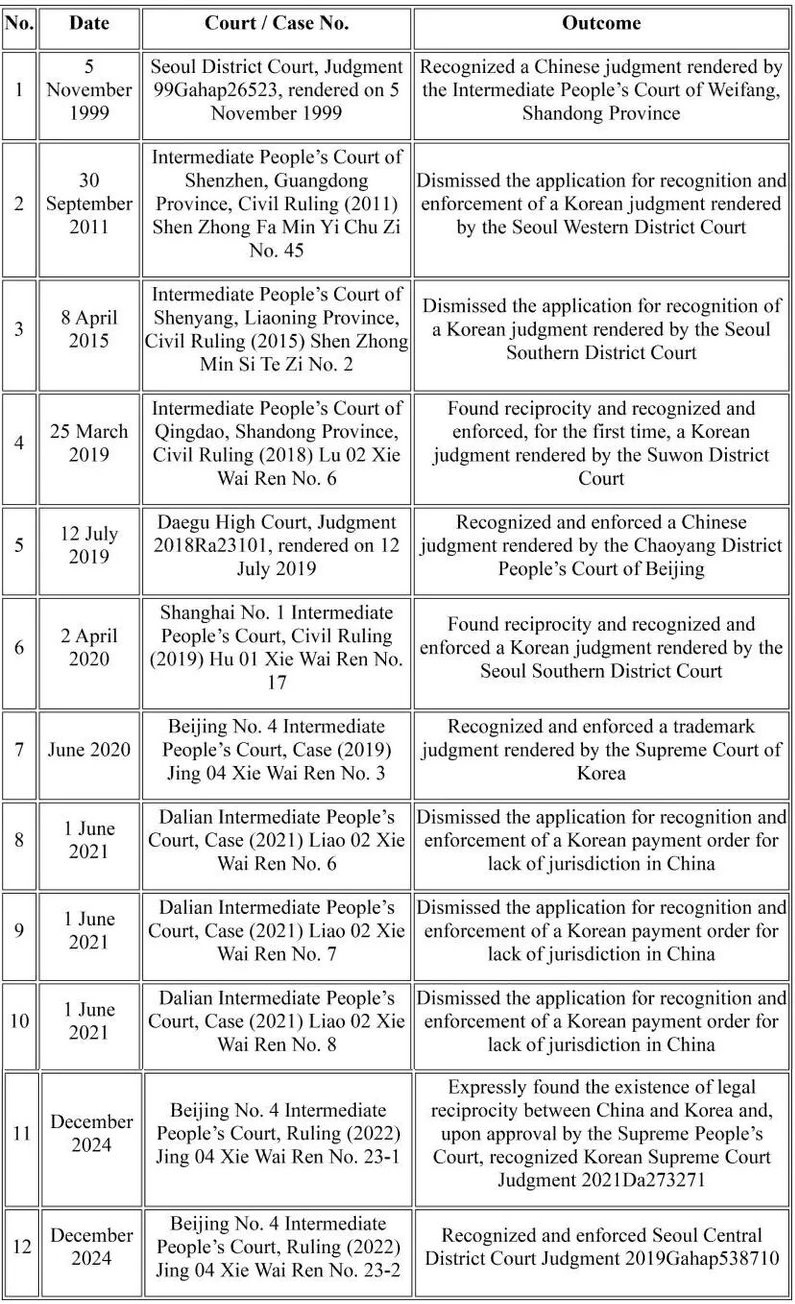
Although the recognition and enforcement of Chinese and Korean judgments in each other’s courts was difficult over the past several decades, the increasing economic, commercial, and civil exchanges between the two states have gradually led to the development of judicial precedents recognizing each other’s judgments, and the rules for determining reciprocity have continued to evolve and improve. Recent cases indicate that the basis for the mutual recognition and enforcement of civil and commercial judgments between China and Korea under the principle of reciprocity has become relatively clear. Nevertheless, each judgment must still satisfy, on a case-by-case basis, the other recognition requirements prescribed under Article 217 of the Korean Civil Procedure Act.
(nine)Which types of foreign civil and commercial judgments can be recognized and enforced in this jurisdiction?
Under Article 217(1) of the Korean Civil Procedure Act, a final judgment rendered by a foreign court, or an adjudication having equivalent effect, may be recognized in Korea if the statutory requirements are satisfied, including the jurisdiction of the foreign court, due service and procedural safeguards, public order, and a guarantee of reciprocity. Where a foreign adjudication is to be compulsorily enforced in Korea, it must also constitute a final adjudication of a foreign court that may be the subject of a judgment of execution under Article 26 of the Korean Civil Execution Act, and must contain specific obligations capable of compulsory enforcement.
As to the substance of the adjudication, in Supreme Court Judgment 2023Da295978, rendered on 30 April 2026, the Supreme Court of Korea held that a “final judgment of a foreign court” under Article 217 of the Korean Civil Procedure Act includes only adjudications that directly determine monetary payment obligations, delivery of property, personal status relationships, or obligations to act or refrain from acting. The judgment further clarified that a judgment of execution may not exceed the scope of the rights already determined by the foreign adjudication. Several representative categories are discussed below.
For judgments concerning divorce, parental authority, custody, and similar matters, a distinction should be drawn between recognition of the marital or personal status determined in the judgment and enforcement of monetary obligations. First, a foreign divorce judgment or other status-forming judgment may have legal effect in Korea if it satisfies the recognition requirements under Article 217 of the Korean Civil Procedure Act. However, its primary effect is to confirm or alter the parties’ legal status, and it does not necessarily mean that the judgment can be compulsorily enforced through Korean civil execution procedures. Secondly, where a foreign divorce judgment contains provisions concerning property payment, transfer of property, child support, spousal maintenance, or other matters requiring compulsory enforcement, the creditor must apply to the competent Korean district court for a judgment of execution under Articles 26 and 27 of the Korean Civil Execution Act. The Korean court will then examine whether the foreign judgment satisfies the requirements for recognition and enforcement under Korean law, and, after rendering a judgment of execution, will confer domestic enforceability in Korea. In judicial practice, Korean precedents have recognized and enforced divorce judgments, judgments concerning child custody and parental authority, judgments ordering payment of child support, and adjudications ordering the return of minor children.
For inheritance-related judgments, a purely procedural adjudication that merely grants the status or administrative authority of an estate administrator, without itself determining substantive rights and obligations capable of direct compulsory enforcement, does not constitute a foreign final adjudication subject to Korea’s judgment-of-execution regime. See Supreme Court Judgment 2023Da295978, rendered on 30 April 2026.
Punitive damages judgments may be recognized in part, subject to conditions. To limit punitive damages and other non-compensatory damages, Korea added Article 217-2 to the Civil Procedure Act on 20 May 2014. That provision states as follows: (1) where a final judgment or equivalent adjudication awarding damages would result in a manifest violation of the fundamental order of the laws of the Republic of Korea or of international treaties concluded by the Republic of Korea, the Korean court shall not recognize all or part of such final judgment or adjudication; and (2) when examining the requirement under paragraph (1), the court shall consider whether the scope of damages recognized by the foreign court includes litigation-related costs and expenses, such as attorneys’ fees.
Accordingly, when recognizing a foreign judgment, a Korean court may refuse to recognize all or part of any damages award that is manifestly inconsistent with Korea’s fundamental legal order. As a result, recognition and enforcement may be granted only for part of the awarded amount. Supreme Court Judgment 2018Da231550, rendered on 11 March 2022, also reflects the position that punitive damages consistent with Korean legal policy may be recognized. Conversely, where the relevant portion of the award manifestly exceeds the scope permitted under Korean law and materially conflicts with Korea’s fundamental legal order, Korean courts may refuse recognition under Article 217-2, as reflected in Supreme Court Judgment 2015Da1284, rendered on 15 October 2015.
Foreign adjudications of a provisional or conservatory nature, such as provisional attachments and preliminary injunctions, cannot be recognized and enforced as foreign judgments. In principle, such adjudications do not constitute foreign final judgments or equivalent adjudications under Article 217(1) of the Korean Civil Procedure Act, and therefore cannot directly acquire enforceability in Korea through the foreign judgment recognition and enforcement regime. Even if assets have already been frozen overseas, a creditor seeking conservatory effect over assets located in Korea must commence separate conservatory proceedings under Korean law and obtain a provisional attachment order from a Korean court. See Supreme Court Judgment 2025Da211405, rendered on 14 May 2026.
(ten)What are the practices and channels for investigating the properties of the executor?
(1) Channels for Investigating the Judgment Debtor’s Assets
① Asset investigation and credit-restriction mechanisms may be used to assist in locating the judgment debtor’s assets. Under the Korean compulsory execution regime, mechanisms relating to asset investigation and credit restrictions in the enforcement of monetary claims mainly include asset disclosure, asset inquiry, and registration in the list of defaulters.
Asset disclosure refers to a procedure under which, where a creditor is entitled to commence compulsory execution for a monetary claim and the debtor’s assets cannot be readily identified, the creditor may apply to the court for an order requiring the debtor to submit an inventory of assets and make a sworn declaration.
Asset inquiry applies in specified circumstances, such as where the asset disclosure procedure cannot proceed smoothly, where the assets disclosed by the debtor are insufficient to satisfy the claim under execution, or where the debtor, without justifiable grounds, fails to appear, fails to submit an asset inventory, refuses to take the oath, or submits a false asset inventory. In such cases, upon application, the court may make inquiries with public authorities, financial institutions, relevant organizations, and similar entities regarding assets held in the debtor’s name.
Registration in the list of defaulters mainly applies where the debtor fails to perform a monetary payment obligation within six months after the enforceable title for such obligation has become final or has been issued, or where the debtor has breached obligations relating to asset disclosure.
The above mechanisms are not “three steps” that must be completed sequentially in every case. Rather, they are separate procedural tools that may be used in Korean compulsory execution proceedings depending on the progress of the case, the debtor’s cooperation, and the asset leads available to the creditor.
② Asset and credit investigations may also be conducted through credit information companies. If court procedures take too long, a creditor holding an enforceable title, such as a judgment, may engage a duly licensed credit information company to assist in investigating the debtor’s credit status. Such companies may obtain publicly available information, including corporate registration and disclosure information, public real estate registers, vehicle registration records, historical records of non-performance or enforcement-related defaults, and publicly disclosed contract information.
However, they are not authorized to access bank transaction records, real-time deposit information, salary accounts, undisclosed equity interests, or private assets. Financial privacy is protected under the Act on Real Name Financial Transactions and Confidentiality, and private institutions cannot conduct look-through inquiries or compel the debtor’s cooperation. If available leads are insufficient, the creditor must still return to the statutory court procedures, such as asset disclosure.
(2) Role of Counsel
Counsel may represent the party in applying to the court for judicial procedures such as asset disclosure and provisional injunctions, and may use the authority of the court to obtain information on the judgment debtor’s assets and seek conservatory measures. Counsel may also obtain publicly registered information, engage credit information agencies to conduct preliminary asset tracing, and initiate appropriate remedial proceedings where the judgment debtor has transferred assets to evade enforcement.
(eleven)What is the framework and standard for attorneys’ fees for the enforcement of foreign civil and commercial judgments? Is a contingency fee possible?
For legal services relating to the recognition and enforcement of foreign judgments in Korea, the fee arrangement may be structured on an hourly-rate basis, a fixed-fee basis, or a contingency-fee basis. Under a contingency-fee arrangement, the legal fees may consist of a base retainer and a success fee. The parties may agree on the payment schedule for the base retainer in installments. The success fee is generally calculated as an agreed percentage of the amounts ultimately recovered through enforcement or received through mediation or settlement, and shall be paid by the client within the agreed period after the client has actually received the corresponding funds.
If a fixed-fee arrangement is adopted, the fee will be negotiated comprehensively by reference to factors such as the amount in dispute, the complexity of the case, the difficulty of cross-border service, and whether the opposing party raises objections. All fee arrangements are subject to case-by-case negotiation, and there is no uniform fixed standard. The specific rights and obligations of the parties, as well as the payment arrangements, shall be governed by the engagement agreement executed by the parties.
ARBITRATION AWARDS
(twelve)Is this jurisdiction a party to the New York Convention?
Yes. Korea formally acceded to the Convention on the Recognition and Enforcement of Foreign Arbitral Awards, commonly known as the New York Convention, on 8 February 1973, and the Convention entered into force for Korea on 9 May 1973. Upon accession, Korea made both a reciprocity reservation and a commercial reservation. Under the reciprocity reservation, Korea applies the New York Convention only to the recognition and enforcement of arbitral awards made in the territory of another Contracting State. Under the commercial reservation, Korea applies the Convention only to arbitral awards arising out of legal relationships, whether contractual or not, that are considered commercial in nature.
(thirteen)What is the approximate time required to register and enforce a foreign arbitration award if unopposed?
For uncontested cases involving foreign arbitral awards, enforcement proceedings before the Korean district court generally take approximately three to six months from filing to enforcement.
(fourteen)What is the approximate time required to register and enforce a foreign arbitration award if opposed?
If the respondent raises objections, the Korean court will need to examine the grounds for refusal of recognition and enforcement set out in Article V of the New York Convention, and the proceedings may be further prolonged, generally taking more than six months.
(fifteen)What is the approximate cost of registering and enforcing a foreign arbitration award (including court fees and other disbursements) if unopposed?
Court fees: The recognition and enforcement of foreign arbitral awards in Korea are generally handled through an application for an enforcement decision, and the court fees are usually lower than those for ordinary civil litigation.
(1) Stamp duty: Where recognition and enforcement of a foreign arbitral award are sought together, the application is generally subject to a fixed stamp duty, which is currently KRW 2,000.
(2) Service fees: Service fees are generally calculated by reference to the number of parties, the fee per service, and the number of prepaid service attempts. Since 1 July 2026, the service fee charged by Korean courts has been adjusted to KRW 5,640 per service. In practice, service fees are usually prepaid on the basis of approximately 2 to 8 service attempts per party. Based on one applicant and one respondent, the service fees would therefore be approximately KRW 22,560 to KRW 90,240. If additional service attempts are required, the court may require further payment.
Other costs: As with applications for the recognition and enforcement of foreign court judgments, other major cost items include Apostille or consular legalization fees for the arbitration agreement and arbitral award, official translation and notarization fees, and attorneys’ fees.
(The specific amount per service and the final total costs shall be subject to the fee standards published by the court at the time of filing and the actual number of service attempts required.)
(sixteen)What is the approximate cost of registering and enforcing a foreign arbitration award (including court fees and other disbursements) if opposed?
If the case involves service-related impediments, objections by the parties, and subsequent appeals through successive instances, the overall costs will increase significantly. However, the fees charged by the court will generally remain limited to fixed stamp duty and service fees. The main cost variations will therefore arise from service expenses and attorneys’ fees. If attorneys’ fees are charged on a fixed-fee basis, they will generally not increase merely because the proceedings are prolonged.
(seventeen)Are there any unusual difficulties in enforcing a foreign arbitration award?
Korea is a Contracting State to the New York Convention, and there is generally no particular difficulty in enforcing foreign arbitral awards in Korea. However, obstacles may arise in the following circumstances.
First, the judgment debtor may raise a defence against duplicate enforcement on the ground that the same debt has already been satisfied through compulsory enforcement proceedings in the state where the award was made. In the case between Chinese company T and Korean company P handled by the author, Korean company P refused enforcement in Korea on the ground that compulsory enforcement had already been commenced in China. However, counsel for Company T submitted evidence showing that the property subject to enforcement in China had failed to sell at auction and that the debt had not been substantially satisfied. After review, the Korean court found that the Chinese enforcement proceedings had not achieved satisfaction of the debt, and that enforcement in Korea would not constitute duplicate enforcement. The court therefore rendered a decision recognizing and enforcing the award, and both appeals filed by Korean company P were dismissed.
Second, service-related difficulties may arise. In a series of international sale of goods disputes between Chinese company J and Korean companies D, W, and S handled by the author, the Korean companies adopted passive strategies such as returned mail, frequent changes of address, and discrepancies in the spelling of their names. The applicants and the arbitral institution cured the procedural deficiencies by verifying the addresses through multiple channels, preserving evidence of returned mail, and engaging a law firm to effect service at the last known addresses and obtain proof of service. The Korean court ultimately held that each respondent had been given proper notice, and that the arbitral tribunal’s hearing in the respondents’ absence did not constitute a procedural violation. All three awards were recognized and enforced.
LIMITATION
(eighteen)What is the limitation period of the enforcement of foreign civil and commercial judgments or arbitration in this jurisdiction?
As a general rule, the limitation period is ten years. Under Article 165(1) of the Korean Civil Act, a claim established by a final and conclusive judgment is subject to an extinctive prescription period of ten years. Accordingly, a foreign judgment or arbitral award is generally subject to a ten-year extinctive prescription period from the time it becomes final, conclusive, and enforceable in the state where it was rendered.
It should be noted, however, that if the law of the state where the original judgment was rendered provides for an extinctive prescription period shorter than ten years, whether the claim has become time-barred may be determined differently depending on the applicable law and the relevant recognition requirements. It is therefore advisable to proceed with enforcement as promptly as possible after the judgment becomes final and conclusive.
ENFORCEMENT
(nineteen)What papers will be needed for the enforcement of a foreign judgment or arbitration award in this jurisdiction?
When applying for recognition and enforcement of a foreign civil or commercial judgment in Korea, it is generally advisable to prepare the following materials:
(1) An application for recognition and a judgment of execution: the application should address Article 217 of the Korean Civil Procedure Act and demonstrate that the foreign judgment has become final and conclusive, and that the requirements relating to international jurisdiction, due service or actual appearance, absence of violation of Korean good morals and public order, and reciprocity or substantial equivalence of recognition conditions are satisfied.
(2) The original foreign judgment or a certified copy thereof.
(3) Documents proving that the foreign judgment has become final and conclusive or effective, such as a certificate of finality, certificate of conclusiveness, or certificate of non-appeal. Article 27 of the Korean Civil Execution Act expressly provides that failure to prove that the foreign judgment has become final and conclusive is a ground for refusing to render a judgment of execution.
(4) Proof of due service or appearance, such as proof of service of the complaint, hearing notice, judgment, or other litigation documents, or materials showing that the defendant actually appeared in the foreign proceedings.
(5) Documents proving the plaintiff’s legal status and capacity, such as a certificate of registration, certificate of good standing, or certificate identifying the legal representative.
(6) Power of attorney and attorney representation documents.
(7) Materials relating to the defendant, such as registration information, address or place of business information, and information on assets located in Korea.
(8) Korean translations. In practice, foreign-language documents such as the foreign judgment, certificate of finality, proof of service, corporate status documents, and authorization documents should generally be accompanied by Korean translations. If the documents are foreign public documents, Apostille or consular legalization may also be required depending on the issuing state.
Arbitral Awards:
(1) Foreign arbitral awards subject to the New York Convention
Under Article IV of the New York Convention, an application in Korea for recognition and enforcement of a Chinese arbitral award should be accompanied by the following documents. In order to obtain the recognition and enforcement referred to in the preceding article, the party applying for recognition and enforcement shall, at the time of application, supply:
(a) the duly authenticated original award or a duly certified copy thereof; and
(b) the original agreement referred to in Article II, namely a standalone arbitration agreement or an agreement containing an arbitration clause, or a duly certified copy thereof.
If the award or agreement is not made in an official language of the country in which the award is relied upon, namely Korea, the party applying for recognition and enforcement shall produce a translation of those documents, namely a Korean translation. The translation shall be certified by an official or sworn translator or by a diplomatic or consular agent. Under current practice, this generally means notarization of the translated documents plus an Apostille.
As to whether, when applying for a judgment of execution of a foreign arbitral award, the applicant must strictly submit the originals or certified copies of the documents specified in Article IV(1) of the New York Convention, the Supreme Court of Korea took the following position in its relevant precedent, Supreme Court Judgment 2004Da20180 rendered on 10 December 2004. First, the original award, arbitration agreement, or certified copies required by the Convention are not procedural prerequisites for the institution of proceedings that the court must examine ex officio, but rather constitute evidentiary rules applicable where a dispute arises. If the parties do not dispute the documents and admit the authenticity of the copies, submission of such copies is equivalent to submission of the originals. Secondly, the requirement under Article IV(2) of the Convention for a certified translation is also not an absolute threshold requirement. If there are defects in the translation, the applicant may cure those defects by commissioning a professional translation at its own expense; the request for a judgment of execution should not be dismissed solely on the ground that an officially certified translation has not been submitted. In simple terms, the translation does not necessarily have to be prepared and signed directly by an official or sworn translator or by a diplomatic officer, so long as the content of the translation can be verified. Likewise, copies of the above documents may be submitted if the opposing party raises no objection and accepts them.
(2) Foreign arbitral awards not subject to the New York Convention
For arbitral awards rendered outside Korea that are not subject to the New York Convention or any other international treaty, recognition or enforcement shall be governed, mutatis mutandis, by Article 217 of the Civil Procedure Act and Articles 26(1) and 27 of the Civil Execution Act. Under Article 37 of the Arbitration Act, the party shall submit the original arbitral award or a copy thereof to the competent Korean court. If the arbitral award is made in a foreign language, a Korean translation shall also be submitted.
In such circumstances, recognition and enforcement of a foreign arbitral award may be carried out only after the Korean court has rendered a judgment of execution. Article 27 of the Civil Execution Act provides that, when rendering a judgment of execution, the Korean court conducts only a formal review. However, if it is not proven that the foreign court judgment has become legally effective, or if the recognition requirements under Article 217 are not satisfied, the action shall be dismissed. A party may appeal against the judgment of execution.
At present, no publicly available Korean court precedent has been identified in which a foreign arbitral award not subject to the New York Convention was recognized and enforced under Article 217 of the Civil Procedure Act.
(twenty)What is the general procedure and methods to enforce a foreign civil and commercial judgment in this jurisdiction (e.g. Garnishee Proceedings, Charging Order, Stop Notice, Enforcement of charging order by sale, Writ of Fi Fa, Examination of judgment debtor, Winding-up Petition,etc.)?
First Stage: Obtaining a Judgment of Execution
Under the relevant provisions of the Korean Civil Execution Act, in order to recognize and enforce a final and conclusive judgment rendered by a Chinese court in Korea, an application must first be filed with the competent Korean court.
(a) Court level: the competent court is the district court.
(b) Venue: the competent court is generally the court of the place where the defendant is located or where the defendant’s assets are located.
In Korean court proceedings, the recognition of the foreign judgment and the rendering of a judgment of execution are handled together.
After the Korean court renders a judgment recognizing and enforcing the foreign judgment, the subsequent enforcement procedure is the same as the enforcement procedure applicable to domestic Korean judgments. With respect to appeals against a judgment of execution, either the plaintiff or the defendant may appeal a first-instance judgment granting or refusing execution.
It should be noted, however, that a Korean judgment of execution for a foreign judgment does not in all cases have to become final before compulsory enforcement may commence. The Korean Civil Procedure Act permits the court to attach a declaration of provisional execution ex officio to judgments concerning proprietary claims. In practice, when Korean courts grant recognition and enforcement of a foreign judgment, they may also declare in the operative part of the judgment that the judgment of execution is provisionally enforceable. Accordingly, for a foreign judgment concerning a monetary payment or other proprietary claim, if the first-instance judgment of execution contains a declaration of provisional or temporary execution, the creditor may apply for an execution clause and proceed with compulsory enforcement against assets even before the judgment of execution has become final, notwithstanding that the opposing party may still appeal.
However, a declaration of provisional execution does not alter the fact that the judgment of execution has not yet become final, nor does it preclude the losing party from filing an appeal. The judgment debtor may challenge the judgment of execution itself on appeal and may apply, in accordance with law, for a stay or restriction of compulsory enforcement. If the appellate court subsequently reverses or modifies the original judgment, the declaration of provisional execution will cease to have effect to the corresponding extent, and any enforcement already carried out may give rise to restitution and damages. Accordingly, the more accurate formulation is that a judgment of execution for a foreign judgment generally serves as the basis for compulsory enforcement after it becomes final; however, where the judgment of execution contains a declaration of provisional execution, the creditor may seek compulsory enforcement before the judgment becomes final, while the judgment debtor may seek relief through an appeal and an application for stay of enforcement.
Second Stage: Taking Compulsory Enforcement Measures Against the Debtor’s Assets Located in Korea
The main enforcement measures include:
(1) Enforcement against claims and third-party debtors, similar to garnishment or third-party debtor proceedings.
(2) Compulsory execution against real property.
(3) Seizure and realization of movable property.
(4) Compulsory execution against specific categories of property, such as vessels, motor vehicles, and aircraft.
(5) Asset disclosure, asset inquiry, and registration in the list of defaulters.
(6) Provisional attachment and provisional disposition.
(twenty-one)How to recover all fees and costs of enforcement?
In Korean litigation, counsel may request, during the proceedings, that litigation costs be borne by the opposing party. The court will make a specific ruling on the allocation of litigation costs in the final judgment.
In principle, such costs are borne by the losing party. If a party prevails only in part, the court may allocate the costs between the parties at its discretion. In practice, such costs are usually apportioned according to each party’s degree of success, although the court is not strictly required to do so.
Litigation costs generally include stamp duties, service fees, and other reimbursable expenses, such as witness daily allowances and copying costs, as well as attorneys’ fees within a prescribed scope. It should be noted, however, that in practice, the full amount of attorneys’ fees actually incurred by a party is not recoverable. Only a fixed amount calculated in accordance with the formula established by the Korean courts may be included in recoverable litigation costs, and that assessed amount is usually far lower than the attorneys’ fees actually incurred by the party. Accordingly, the prevailing party may further seek reimbursement from the losing party for the relevant costs within the scope of litigation costs determined by the court’s judgment.
*Note regarding time/cost estimates throughout this questionnaire:
Time/cost estimates are based on the assumption that the other party fully cooperates with the relevant legal procedures, which rarely happens in practice. Even without opposition, enforcement can face unexpected delays due to changing legislation or bureaucratic administrative delays. Additionally, as litigation in this jurisdiction is adversarial in nature, when litigation is involved, the actual time and costs of the relevant legal procedures are in large part determined by the parties' litigation strategies. As such, it is almost impossible to provide a general but accurate cost/time estimate, and clients should instead seek a case-by-case evaluation for more precise, case-specific estimates.