Key Highlights of the Administrative Measures for Outbound Investment (Revised Draft for Public Comment)
2026-09-07
Introduction: Following the promulgation by the State Council on 5 May 2026 of the Regulations of the State Council on Outbound Investment (State Council Order No. 837, the “New ODI Regulations”, effective 1 July 2026), on 21 August 2026 the National Development and Reform Commission (“NDRC”) released the Administrative Measures for Outbound Investment (Revised Draft for Public Comment) (the “Draft”) and opened it for public consultation. The revision is built on the Administrative Measures for Outbound Investment by Enterprises (NDRC Order No. 11, the “2017 Measures”) promulgated by the NDRC in December 2017, and dovetails with the New ODI Regulations. It represents the most systematic revision of China’s outbound investment regulatory regime since 2017.
On the whole, the revision retains the existing framework, which is built around the approval and filing mechanism and the sensitive/non-sensitive classification, while making substantive extensions in the scope of investors, the information reporting regime, protection of outbound investment, and legal liability, in coordination with the New ODI Regulations. Although the Draft is still at the public consultation stage, it already reflects the overall direction of the revision. This article accordingly compares the revisions in the Draft against the 2017 Measures and sets out the regulatory trends they reflect, for readers’ reference and discussion.
I.Background and Overall Approach
According to the NDRC’s explanatory notes to the Draft, the revision seeks to continue the approval and filing framework established under the 2017 Measures and to give effect to the relevant provisions of the New ODI Regulations. Based on the contents of the Draft, the revisions fall into the following five areas:
First, the scope of investors is expanded to cover resident individuals and other organizations within China, aligning with the definition of investors under the New ODI Regulations;
Second, the approval and filing regime is continued and refined, extending the filing regime to other organizations and resident individuals and adding an exception rule for investments in offshore financial markets;
Third, the information reporting and supervision regime is refined, adding a preparatory work report, an annual outbound investment information report and an outbound investment security review regime, and adjusting rules such as those on overseas reinvestment reporting;
Fourth, an outbound investment protection regime is established, imposing compliance system requirements on overseas entities and setting up a countermeasure mechanism against discriminatory measures as well as a material adverse event reporting mechanism for situations such as foreign requests to transfer technology or data;
Fifth, legal liability is upgraded and strengthened, with the 2017 Measures’ predominantly warning-based sanctions escalated to a composite structure of tiered fines, fines on directly responsible personnel, temporary bans on engaging in outbound investment activities and refusal to accept applications, and financial institutions and professional service providers brought within the scope of compliance obligations.
Each of these areas is analyzed below by reference to the specific provisions.
II.Analysis of the Revisions
(i) Expansion of the scope of investors
The principal revisions in the Draft relating to the scope of investors are set out below:
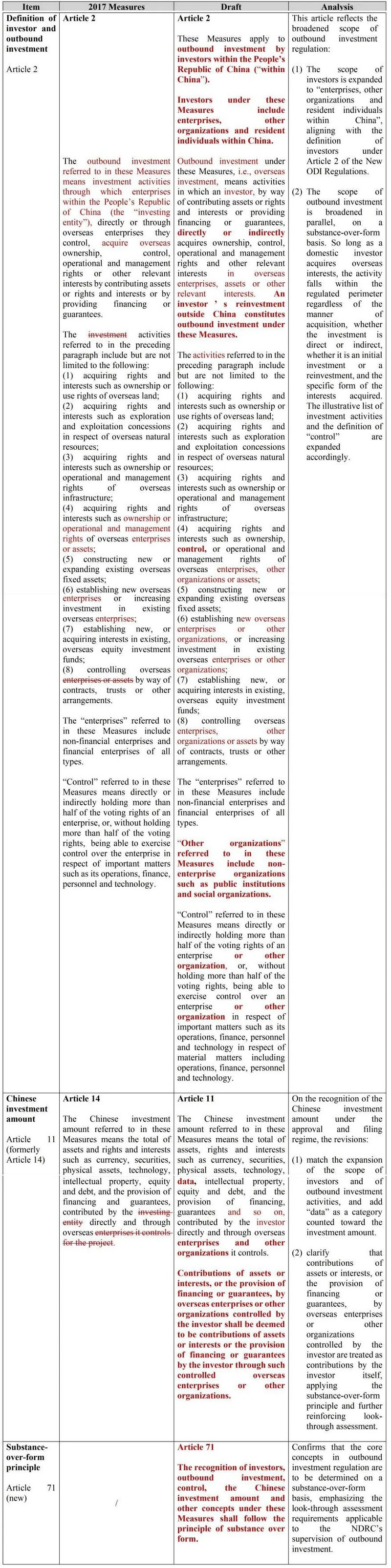
Taken together, these revisions point to the following regulatory trends:
(1) The regulatory perimeter is further broadened. Outbound investment by other organizations and resident individuals is now within the scope of NDRC supervision, and overseas reinvestment is expressly brought within the regulated scope. Previously, outbound investment by domestic natural persons was primarily addressed on the foreign exchange side, through filings under the Circular of the SAFE on Foreign Exchange Administration of Overseas Investments and Financing and Round-Trip Investments by Domestic Residents via Special Purpose Vehicles (Huifa No. 37 [2014], “Circular 37”), and was not directly subject to NDRC supervision. In alignment with the New ODI Regulations, the Draft designates resident individuals as one type of investor and provides that outbound investment by resident individuals is filed with the provincial-level development and reform authority of the investor’s place of household registration or habitual residence.
(2) The rule basis for look-through supervision is clarified. The Draft expressly provides that the NDRC applies the substance-over-form principle in supervising outbound investment, in particular in the recognition of core concepts such as investors, outbound investment, control and the Chinese investment amount. This provides a rule basis for the NDRC to look through multi-tier overseas structures and contractual control arrangements. In our understanding, investment activities at the overseas entity level will be more difficult to structure around NDRC reporting and supervision obligations through artificial transaction splitting.
(3) Increased attention to cross-border data. “Data” is newly added as a category counted toward the Chinese investment amount. Detailed rules on the valuation method and assessment standards for data as a contributed asset have not been issued, and it remains to be seen whether these issues will be addressed in the NDRC’s supporting documents and FAQs. Pending further clarification, for outbound investment projects involving contributions of data assets or cross-border data transfers, investors may wish to engage with the competent authorities in advance to avoid adverse consequences at the approval, filing or overseas reinvestment reporting stage arising from unclear data valuation rules.
(i) Continuation and refinement of the approval and filing regime
The principal revisions in the Draft relating to the approval and filing regime are set out below:
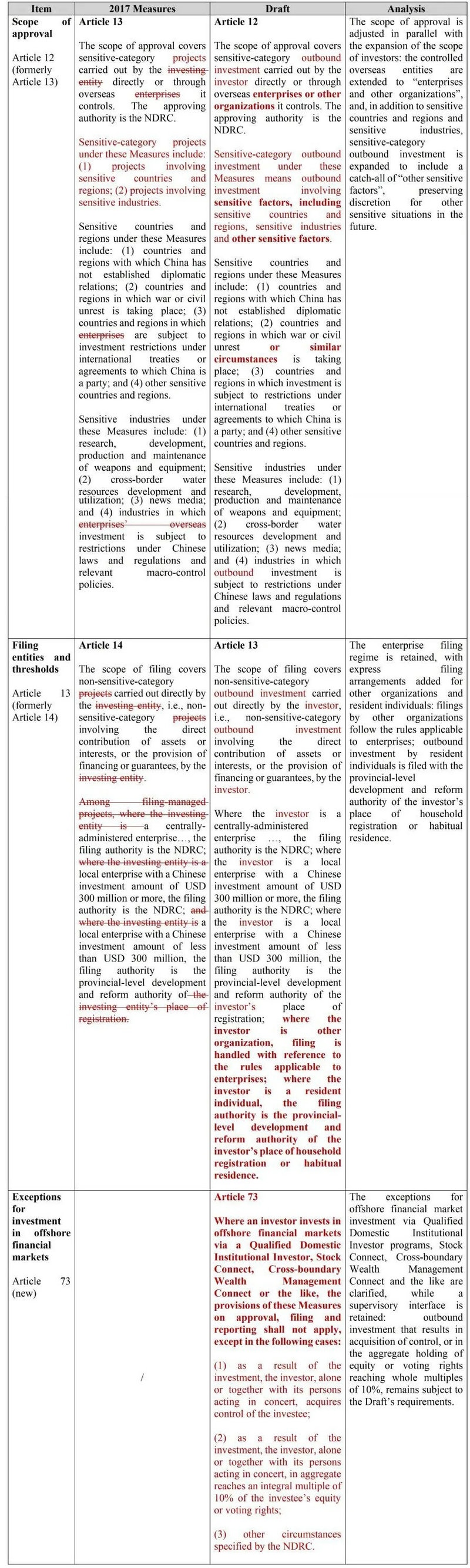
Comparing the old and new regimes, the Draft revises the approval and filing regime on a principle of continuity and refinement:
(1) The core approval and filing framework is preserved in full.The approval and filing framework established under the 2017 Measures and the allocation of approving authorities remain substantially unchanged, consistent with the Draft’s stated approach of overall continuity. That said, following the addition of an “other sensitive factors” catch-all, outbound investment brought within the scope of approval may become open to broader interpretation, pointing overall to a wider regulatory perimeter and tighter supervision.
(2) Filing entities are fully aligned with the expanded scope of investors.To dovetail with the New ODI Regulations, the Draft provides that other organizations file with reference to the rules applicable to enterprises and that outbound investment by resident individuals is filed with the provincial-level development and reform authority of the investor’s place of household registration or habitual residence. Going forward, capital deployment by such entities will need to complete the applicable NDRC formalities in parallel with the applicable foreign exchange registration or filing procedures.
(3) Exceptions for offshore financial market investment are clarified. The Draft expressly disapplies the approval, filing and reporting requirements to Qualified Domestic Institutional Investor programs, Stock Connect, Cross-boundary Wealth Management Connect and similar channels, drawing a clearer line between financial market investment and outbound direct investment and easing the compliance burden of routine cross-border capital markets investment. At the same time, by retaining certain regulatory triggers, investors making larger-scale investments must still comply with the applicable requirements when a specified regulatory trigger occurs.
(iii) Refinement of the information reporting and supervision regime
The principal revisions in the Draft relating to the information reporting and supervision regime are set out below:
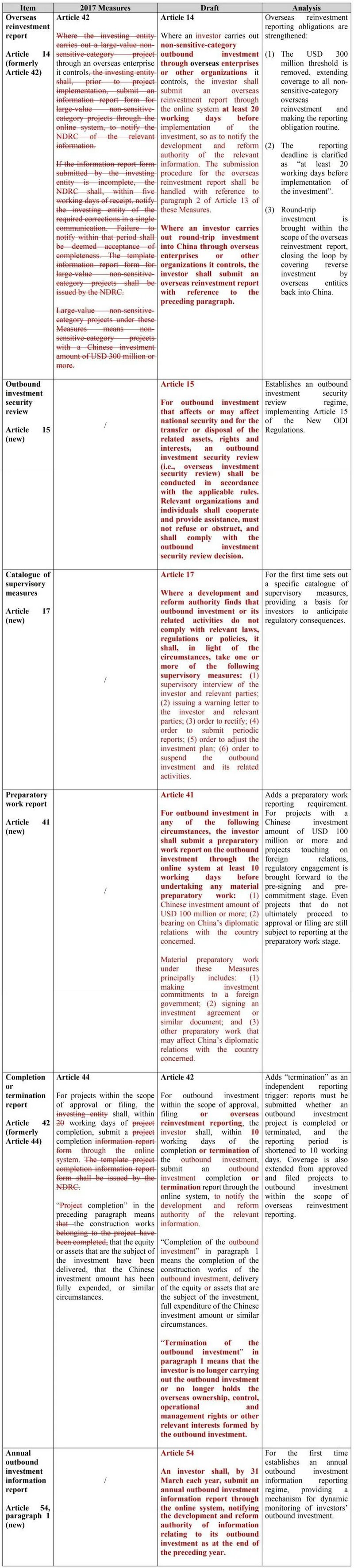
In sum, the Draft adds a number of information reporting and supervision mechanisms, with supervision trending toward full-process and routine oversight, as specifically reflected below:
(1) The regulatory focus extends from ex ante approval to in-process reporting and whole life cycle supervision. The Draft builds an information reporting system covering the entire life cycle of an outbound investment: a preparatory work report before any material preparatory work is undertaken, an overseas reinvestment report before implementation of overseas reinvestment, a completion or termination report after the outbound investment is completed or terminated, and an annual report submitted once a year. The regulatory focus is shifting from ex ante approval to in-process dynamic monitoring, and outbound investment compliance work for enterprises will accordingly extend beyond pre-project approval preparations to full-life-cycle information reporting and cooperation with supervision.
(2) The overseas reinvestment report changes from an exceptional obligation into a routine one. With the USD 300 million threshold removed, overseas reinvestment reports will in principle cover all types of non-sensitive-category outbound investment carried out by domestic investors through overseas enterprises or other organizations they control, extending to related round-trip investment. For Chinese groups with many overseas holding tiers, the space previously afforded by autonomous decision-making at the overseas subsidiary level without notifying domestic authorities is significantly narrowed: each investment activity at the overseas entity level shall be notified to the domestic authorities before implementation, and the corresponding compliance workload will change accordingly.
(3) The outbound investment security review provides an institutional interface for NDRC intervention during project implementation. The Draft carries forward the outbound investment security review regime from the New ODI Regulations, though the trigger criteria, allocation of authority among competent authorities, and review procedures remain to be clarified by dedicated rules. Pending supporting rules, investors in outbound investment projects involving critical technology, critical infrastructure and sensitive industries are advised to assess whether the security review could be triggered and to leave communication and review windows in their project timelines, so as to avoid delays or plan adjustments driven by review.
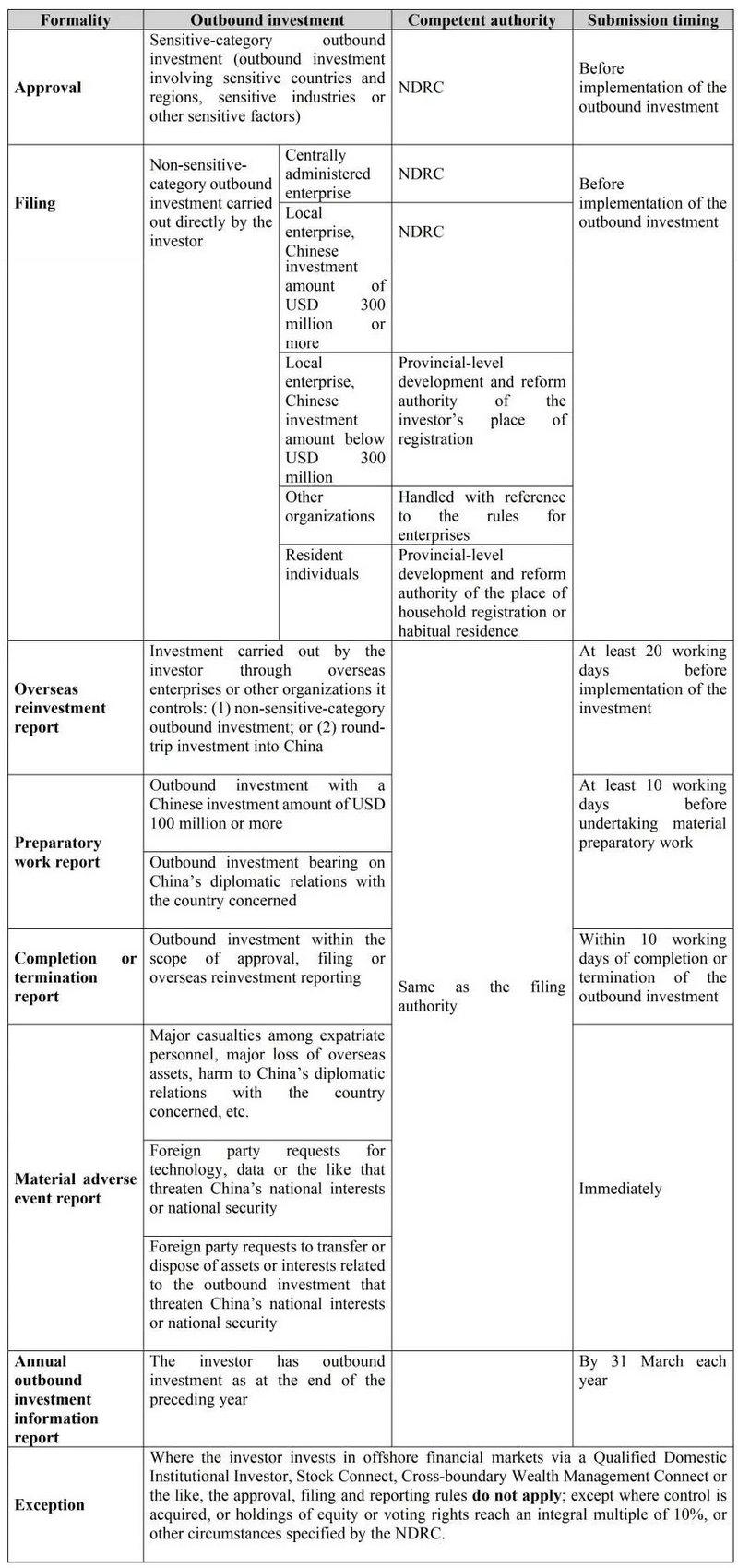
For an overall view of the updated regime, we have compiled the approval, filing and reporting formalities applicable to different types of outbound investment under the Draft, together with the responsible authorities, in the summary table below:
(iv) Establishment of the outbound investment protection regime
The principal revisions in the Draft relating to the protection of outbound investment are set out below:
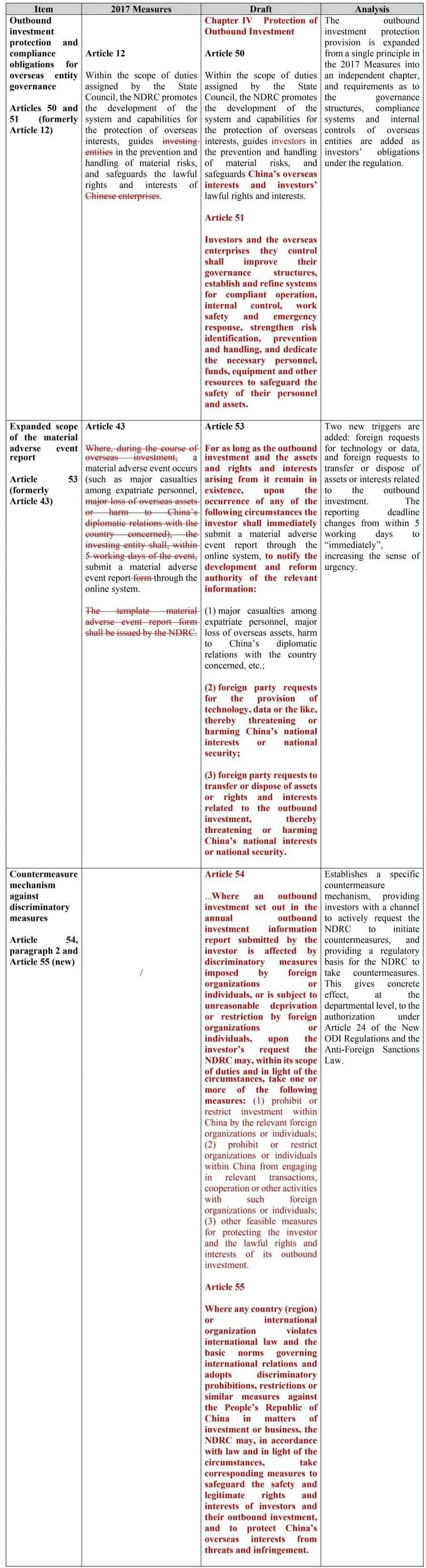
The Draft sets out a systematic outbound investment protection regime in a stand-alone chapter, reflecting the increased attention paid to protecting outbound investment. This is significant against the current backdrop of markedly rising external instability and uncertainty.
On the protection side, the Draft systematizes the outbound investment protection regime, dedicating a stand-alone chapter to the safety of overseas interests, governance of overseas entities, risk alerts, material adverse event reports, annual reports and countermeasures against discriminatory measures. Through the material adverse event report in Article 53 and the annual report regime in Article 54, the Draft establishes a routine channel for Chinese investors to notify the NDRC, on the basis of which the NDRC can take countermeasures such as prohibiting or restricting investment within China by the foreign party and prohibiting or restricting cooperation or dealings between domestic organizations and the foreign party. This is meaningful for investors seeking to protect themselves. For example, remedy clauses in cross-border transaction documents that use sanctions against a counterparty as a trigger event may become more practically enforceable.
While providing protection, the Draft also imposes requirements on the compliance systems of overseas entities, including a requirement for investors and the overseas enterprises they control to establish systems for compliant operation, internal control, work safety and emergency response. While no specific penalties are set out at the legal liability level, the NDRC may still take supervisory measures in respect of non-compliance in light of the circumstances, reflecting a heightened regulatory focus on the compliance systems of overseas entities. For Chinese groups controlling overseas entities, building the compliance systems of overseas entities is no longer optional.
(V)Upgrading and strengthening of legal liability
The principal revisions in the Draft relating to legal liability are set out below:
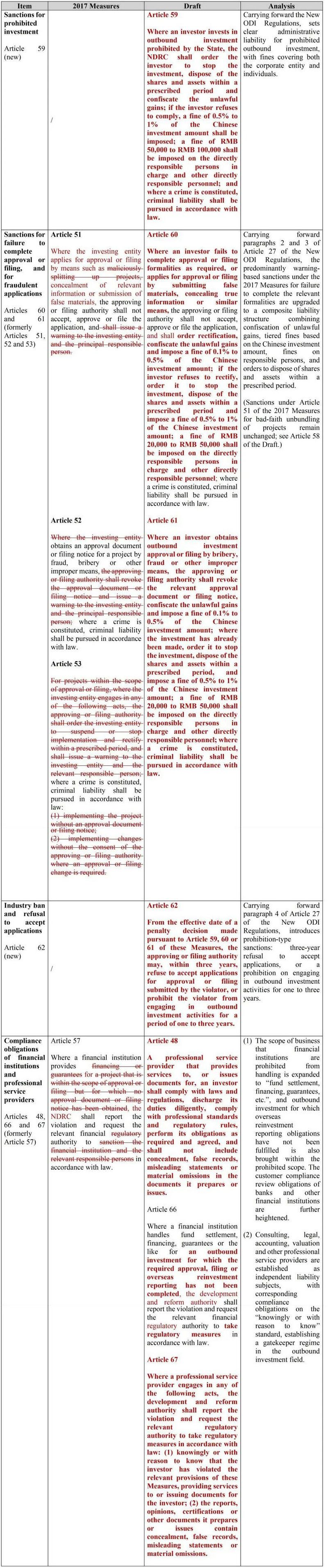
On the legal liability front, the Draft carries forward the New ODI Regulations, significantly strengthens administrative penalties across the board, principally on two dimensions, driving compliance in outbound investment through the cost of non-compliance:
On one hand, legal liability is upgraded from predominantly warnings to a composite structure combining monetary penalties, qualification-based sanctions and joint disciplinary measures. The Draft introduces a multi-layered sanctions regime, including tiered fines calculated at 0.1% to 1% of the Chinese investment amount, fines of RMB 20,000 to RMB 100,000 on directly responsible individuals, a prohibition on engaging in outbound investment activities for one to three years, and a three-year refusal to accept applications. For large-value outbound investment projects, penalty amounts may account for a meaningful portion of project budgets, and the cost of non-compliance provides a quantifiable economic deterrent. At the same time, the cost of non-compliance extends from the enterprise to the individual, strengthening the compliance obligations of directly responsible persons and prompting investors to conduct outbound investment in compliance with the rules and to complete approval and filing formalities.
On the other hand, compliance obligations are extended in parallel to financial institutions and professional service providers. The scope of business that financial institutions may not handle is extended to fund settlement, financing, guarantees and similar businesses, and outbound investment for which overseas reinvestment reporting has not been fulfilled is also within the prohibited scope; the customer compliance review obligations of banks and other financial institutions are correspondingly heightened. Consulting, legal, accounting, valuation and other professional service providers are established as separate regulated parties subject to independent liability. Going forward, financial institutions and intermediaries can be expected to more rigorously assess the compliance obligations and risks of outbound investment projects before taking them on.
III. Conclusion
From the overall trends reflected in the Draft, the NDRC’s approach to outbound investment supervision is moving in three directions. First, the scope of regulated entities extends from enterprises to the full range of enterprises, other organizations and resident individuals; and the mode of supervision is shifting from ex ante approval to a combination of ex ante approval, ongoing reporting and life cycle supervision. Second, the regulatory philosophy places significantly greater weight on national interests and national security, aligning with higher-level legislation such as the Anti-Foreign Sanctions Law through mechanisms such as the outbound investment security review, material adverse event reports and countermeasures against discriminatory measures. Third, compliance responsibilities are allocated across enterprises, responsible individuals, financial institutions and professional service providers, forming a layered framework of accountable compliance obligations.
As at the date of this article, the Draft is still at the public consultation stage, and domestic investors and relevant intermediaries may still submit their views and suggestions to the NDRC in light of their own circumstances. The finalization of the Draft and subsequent supporting documents are worth continued attention, and how the Measures will interact with the regulatory regimes administered by MOFCOM and SAFE will also be a focus of continued observation. We will continue to track developments and update our analysis as appropriate.