ross-Border Enforcement of Civil and Commercial Judgments — France Volume 2 — Points of focus and practical recommendations
2026-08-18
Preamble
This is the second volume of the France instalment of DeHeng Law Offices' Cross-Border Enforcement Guideline series. Volume 1 answers fifteen questions on the recognition and enforcement of civil and commercial judgments between France and the Chinese mainland, and carries the sources, the note on figures and the verification status on which both volumes rest.
This volume takes up the three points on which, in our experience, Sino-French enforcement is most often decided, and on which the short answers of Volume 1 would mislead if read alone: service of process, the boundary of Chinese exclusive jurisdiction, and the reciprocity route. It then sets out what we would advise a client to do about them, and when. It is written to be read after Volume 1, to which its cross-references — to "question 4," and so on — refer.
Part I — Key Issues
Key Issue A — Service of process: three distinct defects, only one of which is fatal
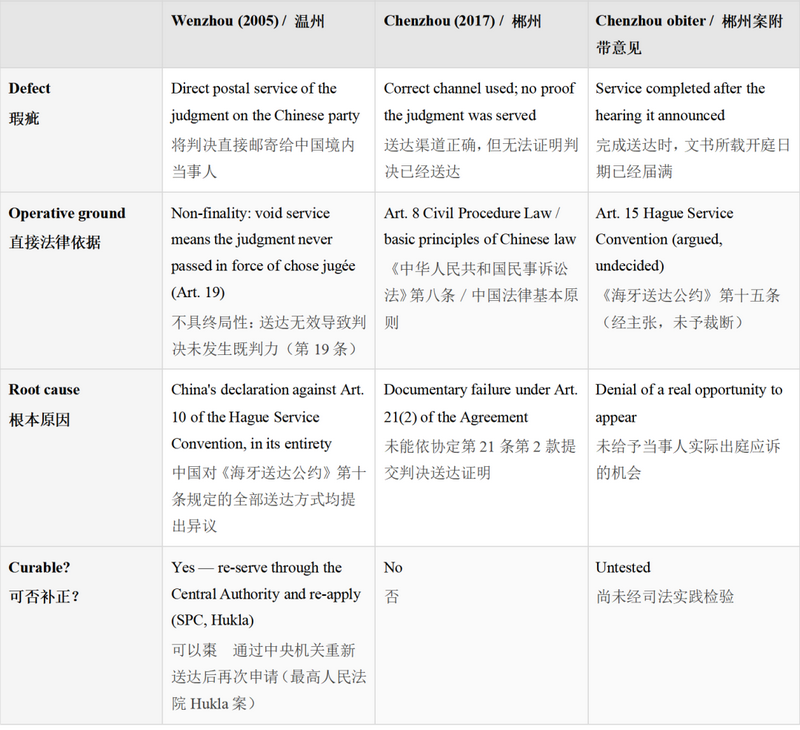
In cases concerning the recognition and enforcement of judgments between France and Chinese Mainland, service is one of the issues most frequently giving rise to non-recognition, and also one of the most commonly misunderstood. Publicly reported cases are often grouped indiscriminately under the general heading of “defective service.” In reality, however, they involve three distinct legal grounds, three different legal consequences, and three different forms of remedial response. The distinction is of considerable practical importance: of the three categories of defect, two are capable of being cured, while only one is irremediable. The full texts of the Chinese court rulings discussed below are not publicly available. The relevant facts are therefore drawn primarily from reports published by China Justice Observer and commentary by Chinese scholars. In the Wenzhou case and the Hukla case, however, the available account is also corroborated by independent Chinese-language sources, and the factual record is therefore comparatively well established.
1. Improper Method of Service — Wenzhou, 13 December 2005
In Case No. (2005) Wen Min San Chu Zi No. 155, Schneider Electric Industries applied for recognition of a judgment rendered by the Tribunal de grande instance de Paris against Wenzhou Feilong Electric Appliances. (This case should not be confused with the much better-known litigation between Chint and Schneider Electric.) The French judgment had been served on the addressee in China by a French judicial officer (huissier) by post, specifically by registered mail with acknowledgement of receipt.
China has declared, under the 1965 Hague Convention on the Service Abroad of Judicial and Extrajudicial Documents in Civil or Commercial Matters (the “Hague Service Convention”), its opposition to the use within its territory of any of the methods of service provided for in Article 10 of the Convention. Service by post was therefore invalid. The defect was not merely one that rendered the service voidable, nor could it be cured by evidence that the addressee had in fact received the documents. Rather, the service was invalid ab initio, because China’s objection protects an interest in state sovereignty and does not turn on whether the addressee acquired actual knowledge of the documents. The Chinese court ultimately declined to recognize the French judgment.
The precise legal mechanism at work deserves careful attention, because the immediate legal basis for non-recognition was not the defect in service as such. The chain of reasoning was as follows: service by post was unlawful; consequently, the judgment had never been validly served; because the judgment had not been validly served, it had not acquired the status of force de chose jugée; and, as a result, the requirements prescribed by Article 19 of the 1987 Agreement had not been satisfied. In case classifications concerning this decision, the ground for non-recognition is accordingly identified as the lack of finality of the judgment, rather than defective service. Put differently, the service defect was the cause, whereas the absence of finality was the legal ground on which recognition was unavailable.
The Supreme People’s Court (“SPC”) reached the same conclusion in Hukla-Werke GmbH Matratzen- und Polstermoebel v. Beijing Fukela Furniture Sales Co., Ltd., SPC Reply No. (2010) Min Si Ta Zi No. 81, dated 23 December 2010, concerning a German judgment. In that case, the summons had been served through the channel of the Ministry of Justice, whereas the judgment itself was subsequently served by post. The SPC’s reply is particularly instructive, and it is so at two distinct levels. The Beijing High People’s Court had initially taken the view that recognition of the German judgment should be refused on public policy grounds. The SPC replaced that analysis with a different legal rationale. Because China did not accept service of the judgment by post, the judgment had “not yet taken legal effect against Beijing Fukela Furniture Sales Co., Ltd.”, and the conditions for recognition of the judgment were therefore “not yet satisfied.” The SPC’s direction to the lower court was explicit: the applicant should be informed that it could first effect service of the judgment through a method recognized under Chinese law and thereafter file a fresh application for recognition. If, however, the applicant insisted on maintaining the application in its existing form, the court should “dismiss the application by ruling.”
This distinction is neither a matter of purely academic taxonomy nor one constructed for the purposes of this article. It is a distinction drawn by the SPC itself. A dismissal of the application leaves the judgment creditor free to effect service afresh through the proper channel and subsequently make a new application for recognition. A refusal to recognize the judgment, by contrast, does not carry the same procedural consequence. Two qualifications should nevertheless be made. First, Hukla-Werke concerned a German judgment, and there is no bilateral judicial assistance treaty between China and Germany governing the recognition of civil and commercial judgments. The SPC therefore dealt with the matter by reference to the Hague Service Convention and the principle of reciprocity. As far as the issue of service is concerned, the reasoning in Hukla-Werke is capable of being transposed to French judgments, because China’s objection to Article 10 of the Hague Service Convention applies equally in relation to France. The broader legal framework governing the two categories of cases is, however, different. Second, it has not yet been verified what final disposition the Beijing court actually entered after receiving the SPC’s above-mentioned direction.
2. Proper Method of Service, but Insufficient Proof — Chenzhou (2017)
The Chenzhou case is commonly cited as an example of a service defect dealt with under Article 22(4) of the 1987 Agreement. On the facts disclosed in the publicly available reports, however, the case cannot properly be classified in that way, nor was the court’s reasoning based on that provision.
In Case No. (2016) Xiang 10 Xie Wai Ren No. 1, decided on 20 June 2017, K.C.C. SARL (la SARL K.C.C.) applied for recognition of a judgment rendered by the Tribunal de commerce de Compiègne on 23 April 2013, Case No. RG 2013F00048. The judgment ordered Chenzhou Hualu Digital Technology Co., Ltd. to pay EUR 383,281.04. The documents instituting the French proceedings had been properly served through the channel of the PRC Ministry of Justice, and service had in fact been effected on three occasions. What the applicant was unable to produce was evidence that the judgment itself had been served: there was no certificate or proof of service, and the Supreme People’s Court had no record showing that the judgment had been transmitted through the relevant channel after April 2013.
According to the available reports, the court did not rely on Article 22(4) of the 1987 Agreement. That provision concerns service of the summons and whether a party who failed to appear had been afforded an opportunity to enter an appearance and defend the proceedings. The court instead reasoned that, because the respondent had not received the judgment, it had been deprived of its right of appeal. This was considered inconsistent with the principle of equality of procedural rights under Article 8 of the Civil Procedure Law of the People’s Republic of China. Recognition was therefore refused on the ground that the judgment contravened the fundamental principles of Chinese law.
The available reports indicate that, among the provisions of the 1987 Agreement discussed by the court, the only provision expressly identified was Article 21. The application fee in the case was RMB 80. We do not draw any inference beyond what the available materials can support. The reports do not establish that the court expressly rejected an analysis under Article 22(4). What they do establish is simply that the court did not, in fact, proceed to analyse the case under that provision.
Two consequences follow, both unfavorable to the judgment creditor. First, the problem originated as an evidentiary deficiency, but its legal effect was elevated into an obstacle at the level of public policy or fundamental legal principles. It was for that reason that the defect proved fatal. Unlike the defects in the Wenzhou or Hukla cases, this was not a problem that could obviously be cured merely by effecting service afresh. Second, the defect lay in the materials submitted in support of the application for recognition and enforcement, rather than in the French proceedings themselves. From the perspective of French law and French procedure, the judgment was entirely lawful, valid, and procedurally regular. It failed to obtain recognition in China because, in 2013, no one had anticipated the need to create and preserve a complete evidentiary record of service of the judgment itself—the very evidence that the Chinese court later required when examining the recognition application in 2016.
3. Proper Method of Service, but Simply Not Enough Time—A Subsidiary Issue in the Chenzhou Case
The Chenzhou case also involved a third category of service-related defect, although the court did not rule on the point. The documents first served stated that an expert examination meeting was scheduled for 27 July 2012, yet Hualu Technology did not receive those documents until 10 October 2012. The French court had allowed approximately four months for service, but, as the case itself demonstrates, that period was insufficient to complete service of judicial documents in China. Hualu Technology therefore invoked Article 15 of the Hague Service Convention. The Chenzhou court did not address that argument in its ruling.
The court’s silence should not be understood as a rejection of the argument. Because the case had already been disposed of on other grounds, the court had no need to determine the issue. The objection therefore remains available to a Chinese judgment debtor faced with comparable circumstances in a future case. Two limitations should, however, be noted. First, Article 15 of the Hague Service Convention applies only where the defendant has not appeared. Second, Article 15 is, in substance, a procedural rule directed to the court rendering the judgment. It requires the court not to give judgment until it is satisfied that the document instituting the proceedings has been duly served and that service was effected in sufficient time to enable the defendant to defend. Article 15 does not itself constitute an independent ground for refusing recognition or enforcement of a foreign judgment. For a Chinese court, the operative ground for refusal should instead remain Article 22(4) of the 1987 Agreement. The function of Article 15 of the Hague Service Convention is to inform the interpretation and application of that provision, rather than independently to supply the ground for non-recognition. On that basis, where the timetable of the French proceedings is structured entirely by reference to assumptions about the speed of domestic French procedure, without taking into account the time actually required to effect cross-border service in China, the procedural timetable itself may, from this perspective, create a potential obstacle to the recognition and enforcement of the resulting foreign judgment. See “Practical Recommendation 4.”
Summary
✦ ✦ ✦
Key Issue B — Article 279 and the boundary of Chinese exclusive jurisdiction
Article 279 of the 2023 Civil Procedure Law reserves to the Chinese courts, exclusively, three categories of foreign-related disputes, in this order: (1) disputes arising from the establishment, dissolution, or liquidation of a legal person or other organisation established in China, and from the validity of the resolutions it adopts; (2) disputes concerning the validity of intellectual property rights examined and granted in China; and (3) disputes arising from the performance in China of Sino-foreign equity joint venture, contractual joint venture, and natural-resources exploration and exploitation contracts. The first two categories were added in 2023; the third is the former Article 273 and dates from 1991.
1. The Legal Mechanism for Refusal of Recognition Is Not the One Commonly Invoked
Most commentary adopts the following analytical route. Article 301 of the PRC Civil Procedure Law provides that a foreign court shall be deemed to lack jurisdiction where its exercise of jurisdiction violates the provisions of the Civil Procedure Law concerning the exclusive jurisdiction of Chinese courts. Article 300(1), in turn, identifies the foreign court’s lack of jurisdiction as one of the grounds for refusing recognition of a foreign judgment. On that basis, the usual conclusion is that, if a French judgment encroaches upon the exclusive jurisdiction of the Chinese courts prescribed by Article 279, a Chinese court will refuse recognition pursuant to Articles 300 and 301.
Our understanding is different, and the distinction has practical legal consequences. Article 271 of the 2023 Civil Procedure Law provides that, where an international treaty concluded or acceded to by China contains provisions different from those of the Civil Procedure Law, the provisions of the treaty shall apply, except for provisions in respect of which China has made a reservation. Article 298 likewise requires a court, in the first instance, to conduct its examination in accordance with the relevant international treaty. Accordingly, where a French judgment falls within the scope of the 1987 Agreement, the review should, in principle, be confined to the six grounds set out in Article 22 of the Agreement. In our view, Article 300 does not additionally supply an independent ground for refusal of recognition. The proper normative route to non-recognition should therefore be through Article 22(1) of the 1987 Agreement, namely, that the judgment was rendered by a court which, under the law of the requested State, lacked jurisdiction. Article 279 of the Civil Procedure Law would then serve to identify the content of the Chinese rule of exclusive jurisdiction said to have been infringed. The ultimate outcome may well be the same, but the legal route by which refusal of recognition is established is different.
The point is not free from doubt, and we do not suggest that the issue has been definitively settled. Article 300 was derived from Article 46 of the 2021 Conference Minutes, which originally began with the qualification “in accordance with the principle of reciprocity.” When incorporating that rule into the 2023 Civil Procedure Law, the legislature deleted that qualification. It has therefore been argued that the review framework established by Article 300 was thereby extended to cases in which recognition is governed by a treaty. There is, however, a competing interpretation. Article 33 of the same 2021 Conference Minutes expressly laid down a rule concerning the scope of application: treaties were to take priority, and the Conference Minutes were to apply only to matters not addressed by the relevant treaty. When the 2023 Civil Procedure Law codified Article 46 of the Conference Minutes, it did not simultaneously incorporate Article 33. As a result, this particular rule governing the relationship between treaty provisions and domestic rules remained outside the text of the statute. Personnel of the Supreme People’s Court who participated in the legislative drafting process have written that bilateral agreements constituted an important reference model in the drafting of Article 300. They have not, however, expressly stated that Article 300 applies to treaty-based cases, nor have they explained the legal significance of deleting the words “in accordance with the principle of reciprocity.”
Our own analysis above also contains a gap that must be acknowledged. The 1987 Agreement does not include fraud as a ground for refusing recognition, whereas Article 300(3) of the Civil Procedure Law expressly does so. The question then arises whether the Agreement’s silence on fraud should be regarded as a “different provision” within the meaning of Article 271, with the result that fraud cannot constitute a ground for non-recognition under the Agreement at all. Alternatively, is this merely a matter on which the treaty is silent, such that Article 300(3) may apply supplementarily to fill the treaty gap?
To our knowledge, there is currently no authoritative basis that clearly supports either interpretation. Until the issue is clarified further, the safest course for a judgment creditor is to ensure that its application for recognition can succeed entirely on the conditions prescribed by Article 22 of the 1987 Agreement itself, without making the outcome of the application depend upon how the foregoing question is ultimately resolved.
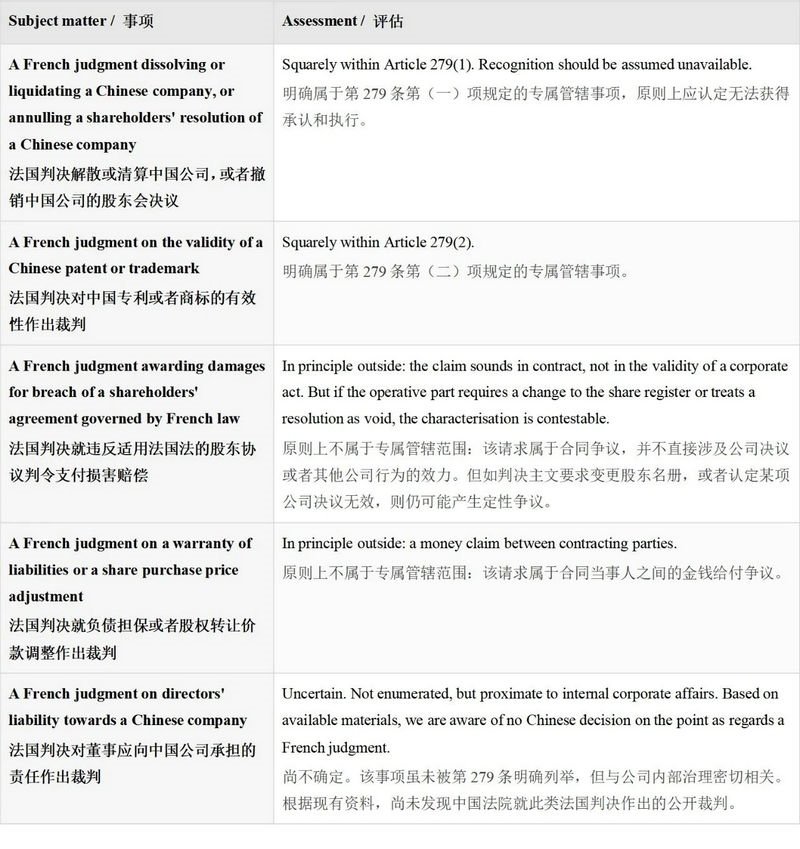
2. What is clearly in, clearly out, and genuinely uncertain
Article 279(1) is drafted around corporate acts, not around corporate subject-matter. The distinction is workable in the clear cases and unstable in the intermediate ones, and the intermediate ones are where Sino-French disputes tend to sit. Where the answer is uncertain, the uncertainty is itself a reason to arbitrate: Article 279 excludes foreign courts, not arbitral tribunals.
3. Insolvency: Not an Issue under Article 279 of the Civil Procedure Law, and No Longer a Matter Governed by the 1987 Agreement Alone
It is sometimes argued that insolvency matters fall outside the scope of the 1987 Agreement, on the ground that collective proceedings appear difficult to reconcile with the requirement under Article 19 of the Agreement that the relevant judgment must have acquired the status of force de chose jugée. The inference is intuitively attractive. It is, however, mistaken in one respect and, more importantly, no longer reflects the current state of the law.
The argument is mistaken because the issue has in fact already been tested in judicial practice, and an application for recognition succeeded. In 2005, the Guangzhou Intermediate People’s Court, acting pursuant to the 1987 Agreement, recognized a French insolvency judgment upon the application of Antoine Montier, liquidator of Pellis Corium “P.E.L.C.O.R”. This was the earliest of the four publicly reported cases in which courts in Chinese Mainland recognized judgments rendered by French courts, and it concerned precisely the type of subject matter that is often said to fall outside the scope of the Agreement.
The point is therefore significant. The 1987 Agreement does not expressly exclude any particular category of subject matter, whether insolvency, social security, or provisional measures. Any proposition that a particular category is excluded from the Agreement is, in substance, an interpretative position rather than a conclusion dictated by the text itself. The Guangzhou case provides, at the very least, a piece of judicial practice weighing against such an interpretation. We have not been able to obtain the judgment in that case. Public sources give different case numbers, referring respectively to (2005) Sui Zhong Fa Min San Chu Zi No. 46 and No. 146.
The practical significance of that precedent may nevertheless be narrower than is sometimes suggested when the case is cited. On this point, we merely reproduce an interpretation advanced in the academic literature and do not express a definitive view. According to one scholarly account, the liquidator in the Guangzhou case sought recognition of the French insolvency judgment solely in order to complete registration formalities for the transfer of real property owned by the company in China, and the application did not involve the proprietary interests of any party. The same account places the case alongside two other publicly reported Mainland Chinese cases involving recognition of foreign insolvency judgments—Re B&T Ceramic Group S.R.L. and Re Sascha Rudolf Seehaus—and argues that the effect achieved in all three cases went no further than recognition of the legal status of the foreign insolvency representative. On that account, none of the three decisions produced a stay of individual enforcement proceedings, nor did any of them commence ancillary insolvency proceedings in China. Because we have not been able to review the judgment in the Guangzhou case, we cannot independently verify that characterization. It is therefore presented here only as a possible interpretation. Whether or not that interpretation is ultimately correct does not affect the analysis that follows.
More importantly, the proposition that insolvency matters are governed solely by the 1987 Agreement is now outdated. Article 5 of the Enterprise Bankruptcy Law of the People’s Republic of China, which took effect on 1 June 2007, two years after the Guangzhou decision, now specifically governs the recognition of foreign insolvency judgments and rulings insofar as they affect property of the debtor located in Chinese Mainland. Article 5 treats an international treaty as one of the legal bases upon which a recognition application may be examined. It provides that the People’s Court shall examine such an application “in accordance with an international treaty concluded or acceded to by the People’s Republic of China, or on the basis of the principle of reciprocity.” The Enterprise Bankruptcy Law, however, does not stop there. Article 5 imposes additional conditions that do not appear in the 1987 Agreement itself. Recognition of a foreign insolvency judgment must not contravene the basic principles of Chinese law, prejudice the sovereignty, security, or public interest of the State, or impair the lawful rights and interests of creditors within Chinese Mainland.
The last of these requirements has no equivalent in Article 22 of the 1987 Agreement and may, in cases involving French insolvency proceedings, prove decisive. Where a foreign liquidator seeks to remit assets located in China abroad, the proposed disposition will, by its very nature, almost inevitably raise the question whether the interests of creditors located in China may be adversely affected. The practical conclusion is therefore neither as broad as the more optimistic interpretation suggests nor as restrictive as the more pessimistic view assumes. French insolvency judgments are not excluded from the scope of the 1987 Agreement, and their recognition does not therefore have to fall back exclusively upon a reciprocity-based route that has received only limited judicial testing. At the same time, recognition is not governed by the Agreement alone. The operative legal framework is Article 5 of the Enterprise Bankruptcy Law. The 1987 Agreement supplies only the first layer of the legal basis for recognition. In addition, the foreign insolvency judgment must satisfy a further review specifically designed to protect creditors in Chinese Mainland. A French judgment creditor or insolvency representative bringing such an application should therefore expect the Chinese court to apply that additional standard in practice.
✦ ✦ ✦
Key Issue C — Reciprocity: not a gap in the case law, but a route that is unavailable
China’s judicial practice concerning the principle of reciprocity has undergone a fairly significant evolution within a relatively short period of time.
Under the standard of de facto reciprocity, a judgment creditor was required to prove that a court of the relevant foreign jurisdiction had previously recognized a judgment rendered by a Chinese court. For most jurisdictions, this requirement was plainly circular in nature and, in practice, was often impossible to satisfy.
The Nanning Statement of the Second China-ASEAN Justice Forum, adopted in Nanning on 8 June 2017, introduced the concept of presumed reciprocity in Article 7. In relation to a country with which no international treaty concerning the recognition and enforcement of foreign civil and commercial judgments had been concluded, reciprocity could, to the extent permitted by domestic law, be presumed where there was no precedent in which a court of that foreign country had refused to recognize a Chinese judgment on the ground that no reciprocal relationship existed.
Article 44 of the 2021 Minutes of the National Symposium on Foreign-related Commercial and Maritime Trial Work of Courts Nationwide further established a standard of de jure reciprocity. Under that provision, a reciprocal relationship may be found to exist where any one of the following circumstances is present: (1) under the law of the country in which the judgment was rendered, civil and commercial judgments of Chinese courts are capable of being recognized and enforced in that country; (2) China and that country have reached a reciprocal understanding or consensus; or (3) that country has made a commitment to reciprocity with China through diplomatic channels, or China has made such a commitment to that country through diplomatic channels, and there is no evidence that the country has previously refused to recognize or enforce a Chinese judgment on the ground that no reciprocal relationship existed.
The 2021 Minutes further provide that the existence of reciprocity is to be determined on a case-by-case basis.
It is worth noting, incidentally, that as a matter of grammatical structure, the final qualification—namely, that “there is no evidence that the country has previously refused to recognize a Chinese judgment on the ground that no reciprocal relationship existed”—modifies only the third of the above circumstances. In a number of secondary sources, however, that qualification is frequently described as applying to all three criteria.
Article 298 of the 2023 Civil Procedure Law of the People’s Republic of China has now incorporated the principle of reciprocity into statutory law.
As far as France is concerned, it is fully capable of satisfying the first of the above criteria. Since 2007, French law has recognized foreign judgments by reference to the conditions established in Cornelissen, without requiring reciprocity as a condition of recognition.
To date, however, no Chinese court is known to have recognized a French judgment through the reciprocity-based route.
1. The Absence of Cases Does Not Mean That There Is a Legal Vacuum
It is easy to interpret this “silence” as an absence of precedent and then to ask how a Chinese court would apply the principle of reciprocity when confronted with a French judgment for the first time. That, however, is not quite the right way to frame the question. For French judgments, the reciprocity-based route is not merely one that has yet to be tested in practice; within the scope of the applicable treaty, it is simply unavailable.
Article 298 of the 2023 Civil Procedure Law requires the People’s Courts to apply the relevant international treaty in the first instance. Article 33 of the 2021 Conference Minutes likewise expressly provides that, where an international treaty exists, the matter shall be handled in accordance with that treaty, and that the Conference Minutes apply only supplementarily where no treaty exists or where the treaty does not address the relevant issue. Since 8 February 1988, French civil and commercial judgments have, in principle, been governed by the 1987 Sino-French Agreement on Judicial Assistance. When dealing with such judgments, Chinese courts have neither the need nor the basis to undertake a separate inquiry into reciprocity. The fact that no court has applied the principle of reciprocity in this context does not reveal a gap in the case law; rather, it indicates that the treaty mechanism is operating as intended.
The point is of even greater practical significance when viewed from the opposite direction. The Nanning Statement expressly applies only to countries that have not concluded a relevant treaty. Article 44 of the Conference Minutes likewise addresses situations in which no applicable treaty exists, while the prior-reporting mechanism under Article 49 applies only to cases examined on the basis of reciprocity. These are therefore not requirements that a French judgment creditor would ordinarily need to confront.
A French judgment creditor has not lost access to the reciprocity route; rather, there is no need to rely on it. The creditor may proceed directly under the treaty framework, which is more favorable, more predictable, and subject to a comparatively closed set of grounds for refusal of recognition.
2. The Circumstances in Which Reciprocity Analysis Truly Matters
The advantage of not having to establish reciprocity is not, however, without limits, and identifying those limits is of considerable practical importance. The principle of reciprocity becomes relevant to a French judgment creditor only where the application in question falls outside the scope of the 1987 Sino-French Agreement on Judicial Assistance. The appropriate approach is neither to be unduly optimistic nor excessively cautious, but rather to identify with precision the relatively limited categories of cases that may fall outside the Agreement.
The Agreement does not expressly exclude any particular subject matter. Its scope should instead be determined by reference to the conditions prescribed in Article 19: whether the decision is a civil or commercial judgment, whether it was rendered after 8 February 1988, and whether it has taken legal effect and is final. The categories genuinely capable of falling outside the Agreement are therefore relatively limited, although they tend to involve difficult issues. They include judgments rendered before February 1988, judgments lacking finality—provisional measures commonly encounter this difficulty—and matters that may, by their nature, fall outside the civil and commercial sphere. Insolvency is also sometimes placed in this category, but, as explained in Issue B, that should not, in principle, be the correct approach.
Where an application genuinely falls outside the scope of the Agreement, the judgment creditor may instead seek recognition on the basis of reciprocity. Under the standard of de jure reciprocity, France should, in principle, satisfy the relevant requirement. This would, however, require the creditor to ask a Chinese court to render a decision that, to date, no Chinese court is known to have rendered in relation to a French judgment. Moreover, the very reason for resorting to reciprocity would be that the case falls outside the treaty framework ordinarily applicable to French judgments, with the result that there would be little precedent directly supporting the application.
In those circumstances, the applicant should affirmatively and fully plead de jure reciprocity and submit comprehensive materials establishing the relevant rules of French law, rather than simply assuming that reciprocity will be found to exist. The applicant should also make a realistic assessment, from the outset of the proceedings, of the costs and uncertainties involved.
More importantly, parties should, wherever possible, structure their arrangements so as to avoid having to rely on the reciprocity route at a later stage. Whether a particular application will fall within the scope of the 1987 Sino-French Agreement on Judicial Assistance is often determined years before recognition is ever sought—at the stage when the underlying contract is drafted and the mechanism for dispute resolution is selected.
Part II — Practical recommendations
The following reflect the views of the authors based on the materials discussed above and on our own practice. They are general in nature and no substitute for advice on a specific matter.
1. Give Priority to Arbitration, and Let Enforceability Determine the Dispute Resolution Clause—not the Other Way Around
The institutional differences discussed in Question 3 are not merely a matter of party preference. Arbitral awards are capable of circulating across jurisdictions under the New York Convention, whereas court judgments depend on a bilateral treaty whose scope may prove narrower than the parties anticipated and remain subject to close scrutiny of service records dating back many years. An arbitration clause may also avoid, at the same time, both the risks associated with exclusive jurisdiction under Article 279 (see “Key Issue B”) and those arising from defective service (see “Key Issue A”). If the counterparty nevertheless insists on a court jurisdiction clause, the first question at the contract-drafting stage should not be which court is the most convenient forum, but rather whether a judgment rendered by that court will ultimately be capable of recognition and enforcement in the jurisdiction where the debtor’s assets are located.
2. Do Not Wait Until After Obtaining Judgment to Investigate Assets; Begin Before the Need Arises. The Beijing Fourth Intermediate People’s Court Case Is a Clear Illustration
Recognition of a judgment does not mean that the judgment creditor will actually recover the amount awarded, and the gap between the two can be substantial. In the Beijing Fourth Intermediate People’s Court case, the judgment creditor successfully obtained recognition of a French order involving an amount exceeding US$46 million. According to publicly available reports, however, the only asset ultimately reached in enforcement was the cash surrender value of an insurance policy held in the debtor’s name, amounting to approximately RMB 190,000, or roughly US$27,000. The available materials do not make clear whether the creditor subsequently identified any other assets. That uncertainty itself illustrates the problem: by the time recognition has been obtained, the assets still available for attachment may consist only of whatever the debtor has not transferred away during the intervening years. When seeking property preservation measures in China, a creditor will generally need to provide highly specific information identifying the assets to be preserved, such as bank account details, specifically identified real property, or precise information concerning equity interests. Such information cannot realistically be investigated and assembled at short notice. The same case also demonstrates that a judgment creditor may seek preservation measures from the time the application for recognition is filed. The court issued its property preservation order on 10 August 2017, approximately three years before it rendered the recognition ruling in 2020. Asset investigations should therefore begin once a dispute has become a realistic prospect, rather than only after the foreign judgment has become final.
3. Service in China Should Be Effected Through the PRC Ministry of Justice; Any Other Channel Should Be Treated as Defective
China has declared its opposition to the use within its territory of all methods of service contemplated by Article 10 of the Hague Service Convention. This opposition extends not only to service by post, but also to the direct transmission of judicial documents between judicial officers and to service effected by judicial officers of the requested State upon the direct request of an interested party. Service by post is therefore not a shortcut that may be attempted subject merely to an increased degree of risk. It is invalid ab initio. Nor can the defect be cured by proof that the addressee actually received the documents. See “Key Issue A.” The proper channel for service of judicial documents in China is through China’s designated Central Authority, the Ministry of Justice of the People’s Republic of China. The process may take considerable time, but it is not a procedural requirement that parties are free to circumvent.
4. Structure the French Proceedings Around the Time Required for Service in China, and Preserve the Service Documentation as Evidence—Because That Is Precisely What It Is
The Chenzhou case offers two practical lessons. Neither is costly to implement at the outset, but both may be impossible to cure once the underlying proceedings have concluded. First, where the defendant is located in China, a French court fixing a hearing date only four months after commencement of proceedings may well mean that the hearing takes place before service of the originating process in China has been completed. If the defendant fails to appear, this may provide a basis for objection under Article 15 of the Hague Service Convention. As a practical matter, the procedural timetable should therefore allow approximately twelve months for service to be effected in China. Second, and more importantly, parties should obtain and retain on a long-term basis proof of service of the judgment itself, rather than preserving only proof of service of the originating process. Article 21(2) of the 1987 Sino-French Agreement on Judicial Assistance requires the applicant to submit separately the original service document evidencing that the judgment has been served. The decisive difficulty in the Chenzhou case was the absence of that document, which prevented recognition from being granted. The document that most needs to be preserved in advance is therefore often the very document most easily overlooked at the conclusion of the French proceedings.
5. Calculate the Two-Year Limitation Period from the Time for Performance Specified in the French Judgment, Not from Any Subsequent Proceedings in China
Article 545 of the Interpretation of the Supreme People’s Court on the Application of the Civil Procedure Law of the People’s Republic of China expressly provides that the two-year period for applying for enforcement prescribed by Article 250 of the Civil Procedure Law applies equally to applications for the recognition and enforcement of foreign judgments. The real risk lies in determining when that period begins to run. According to the wording of Article 250, where the judgment specifies a period for performance, the two-year period runs from the last day of the period for performance specified in the French judgment. Service through the Central Authority alone may take eight to twelve months, while preparing and translating the application materials required under Article 21 of the 1987 Sino-French Agreement on Judicial Assistance may take several additional months. A French judgment may therefore already be time-barred for purposes of an application for recognition and enforcement in Chinese Mainland, while remaining enforceable in France for a further nine years under Article L.111-4 of the French Code of Civil Enforcement Procedures (Code des procédures civiles d’exécution). The limitation regimes in the two jurisdictions operate independently, and the applicable period in China is markedly shorter. Accordingly, once a French judgment has been rendered, the deadline for seeking its recognition and enforcement in Chinese Mainland should be identified immediately, formally recorded, and continuously monitored.
6. Expressly Provide for the Recovery of Legal Fees in the Contract, as Chinese Courts Will Not Ordinarily Award Them as a Matter of Course
In Chinese Mainland, unless the contract expressly provides that legal fees are to be borne by the breaching party, or a specific rule of law provides otherwise, a judgment creditor will, in principle, be unable to recover its legal fees from the judgment debtor. See Question 15. Accordingly, even where the creditor ultimately succeeds in full, the EUR 20,000 to EUR 60,000 in costs associated with recognition and enforcement may remain a net expense borne by the creditor itself. This is a risk that can be addressed at virtually no additional cost when the contract is drafted, but which will usually be difficult, if not impossible, to cure once a dispute has arisen. The contract should therefore expressly provide that all costs incurred in enforcing the creditor’s rights and in obtaining recognition and enforcement of any judgment, including legal fees, are to be borne by the party responsible for the breach.
7. Review the Relief Sought Against Article 279 Before Commencing Proceedings in France, Rather Than Attempting to Cure the Problem After Judgment
Where a French judgment concerns a matter falling within the exclusive jurisdiction of the Chinese courts, there is a risk that recognition and enforcement will be refused, irrespective of the precise legal route by which that conclusion is reached. See “Key Issue B.” Although Article 279 identifies the relevant categories of matters in relatively clear terms, the precise boundaries of those categories are less certain, and Sino-French cross-border disputes frequently arise close to those boundaries. If the operative part of the judgment to be sought from a French court would concern the incorporation, dissolution or liquidation of a Chinese entity, or the validity of its internal resolutions, the claims and relief sought should be restructured or severed before proceedings are commenced, or the dispute should instead be referred to arbitration. There is little practical value in incurring the full cost of litigation, obtaining a favorable judgment, and only then discovering that the judgment cannot be enforced in China. In economic terms, that may amount to having obtained no effective recovery at all.