How the PPWR Regulations Are Reshaping the Cost Allocation and Power Dynamics in the China-EU Packaging Supply Chain:A Practical Guide for Chinese Companies on Dealing with PWRs
2026-08-06
Introduction
August 12, 2026, is a date that many Chinese export companies were previously unfamiliar with but will need to keep in mind going forward. On this day, the European Union’s Packaging and Packaging Waste Regulation (PPWR) will take full effect across all 27 member states. It is not a directive that requires national transposition and allows for a gradual adjustment period, but rather a regulation that takes effect immediately, leaving little room for maneuver. For Chinese manufacturers, brands, and cross-border e-commerce sellers exporting products to Europe, this means that packaging—which was often viewed in the past as the least significant and most easily cut cost—is now becoming a compliance matter requiring dedicated personnel, independent test reports, and separate registration and fee payments in multiple countries. This article aims to translate the PPWR—a voluminous regulation with numerous provisions—into a practical guide that Chinese companies can use to directly assess and implement the requirements for their own operations: what exactly has changed, who is responsible, where the costs lie, and what preparatory steps can be taken right now.
I. Specific Background
The Packaging and Packaging Waste Regulation (PPWR, (EU) 2025/40) is the legislative successor to the Packaging and Packaging Waste Directive (PPWD, 94/62/EC). Against the backdrop of the gradual implementation of corporate social responsibility regulations such as the European ESG Omnibus Act, the CSRD, and the CSDDD, the introduction of the PPWR represents a crucial step in extending the EU’s green and sustainable requirements to the level of specific products.
In 2022, the European Commission proposed a comprehensive reform of the PPWD. As the PPWD is a directive, it does not have direct legal force; it must be transposed into national law by each member state to take effect. However, the pace and rigor of transposition have varied widely among member states, failing to effectively curb the growth of packaging waste or reduce the actual environmental impact of packaging. Countries such as Germany, France, and Italy have each established their own packaging recycling registration systems (e.g., Germany’s LUCID and France’s CITEO), which are not interoperable. As a result, companies entering different markets must repeat the entire process of registration, reporting, and fee payment. This is precisely why the EU decided to move away from directives and instead adopt a single PPWR to unify the rules. Beyond the difference in legal force, the PPWR also represents a clear expansion in substantive requirements. The PPWD largely remained focused on recycling and recovery targets for packaging waste and imposed almost no mandatory, quantitative thresholds on the design of packaging itself. By contrast, the PPWR introduces, for the first time, a quantifiable recyclability grading system (Article 6 and Annex II), minimum recycled plastic content requirements (Article 7), harmonized substance restrictions centered on heavy metals and PFAS (Article 5), as well as quantitative requirements concerning packaging minimization and void space ratios (Article 10 and Annex IV). Put differently, the PPWD governed where packaging waste should go, whereas the PPWR governs what packaging must look like from the design stage onward.
It should be further clarified that the direct applicability of the PPWR does not mean that every detail has been settled once and for all at the EU level. The structure of the PPWR still leaves Member States with two types of discretion. The first concerns institutional choices, such as whether producers must be required to join a producer responsibility organization under Article 46(1). This allows Germany to retain its long-established dual recycling system. The second—which will be discussed in greater detail later in this article—arises under Article 68, which leaves the level and types of penalties, as well as the designation of competent enforcement authorities, to the Member States. The PPWR merely requires penalties to be effective, proportionate, and dissuasive, while the specific amounts are determined entirely under national law. In addition, a considerable number of technical details under the PPWR—including the final design of harmonized sorting labels and the methodology for assessing recyclability grades—will only become clear once the European Commission adopts the relevant delegated acts and implementing acts. Although these measures will still be adopted at the EU level, they will be issued in stages. Companies should therefore not assume that all implementing details will have been fully settled after August 12, 2026.
In December 2024, the European Parliament and the Council of the European Union formally adopted the text of the PPWR; on January 22, 2025, the text was officially published in the Official Journal of the European Union under the reference number (EU) 2025/40; On February 11, 2025, the regulation officially entered into force. In accordance with the 18-month transition period established by the regulation, the PPWR will be fully applicable to all 27 member states on August 12, 2026, at which point the PPWD will be repealed. It should be noted that “full application” does not mean that all provisions take effect simultaneously—the PPWR itself is a regulation implemented in phases. The requirements for label standardization are not expected to be fully implemented until around 2028, the mandatory thresholds for recyclability classifications will not take effect until 2030, and the requirements for large-scale recyclability are scheduled for 2035.
The PPWR was not introduced in isolation but is part of a series of corporate sustainability regulations under the framework of the European Green Deal. Advancing in tandem with it are the Corporate Sustainability Reporting Directive (CSRD) and the Corporate Sustainability Due Diligence Directive (CSDDD): the former requires companies to disclose environmental, social, and governance (ESG) information in accordance with the harmonized European Sustainability Reporting Standards (ESRS), while the latter mandates that companies fulfill due diligence obligations regarding human rights and environmental impacts in their own operations and throughout their value chains. These regulations were originally expected to become increasingly stringent and to expand in scope, but the situation has taken a marked turn over the past year or so. In April 2025, the EU adopted the “Stop-the-Clock” Directive, postponing the application of the CSRD for second- and third-wave companies by two years overall and delaying the initial application period for the CSDDD by one year; On February 26, 2026, the EU formally adopted the “Omnibus I” package, which significantly narrowed the scope of the CSRD—raising the threshold so that only companies with more than 1,000 employees and net revenue exceeding 450 million euros are required to disclose information. As a result, approximately 31,000 medium-sized enterprises that were previously expected to be included were excluded; The scope of liability and penalties under the CSDDD were also tightened simultaneously. In other words, rather than continuing to expand in 2026, the European ESG regulatory framework underwent a systematic streamlining and downsizing. As things stand, the PPWR has not been included in this round of simplification. The European Commission also explicitly stated in its subsequently issued guidance documents that the interpretation of specific provisions under the PPWR is being conducted against this broader backdrop, but the core obligations of the PPWR itself have not been reduced. For Chinese exporters, this implies an important takeaway: while they can moderately ease their concerns regarding the direct applicability of the CSRD and CSDDD (unless they are among the very few conglomerates with over 1,000 employees and substantial revenue from the EU), they must not mistakenly project this perception onto the PPWR—there are currently no clear signs of a slowdown in packaging compliance requirements.
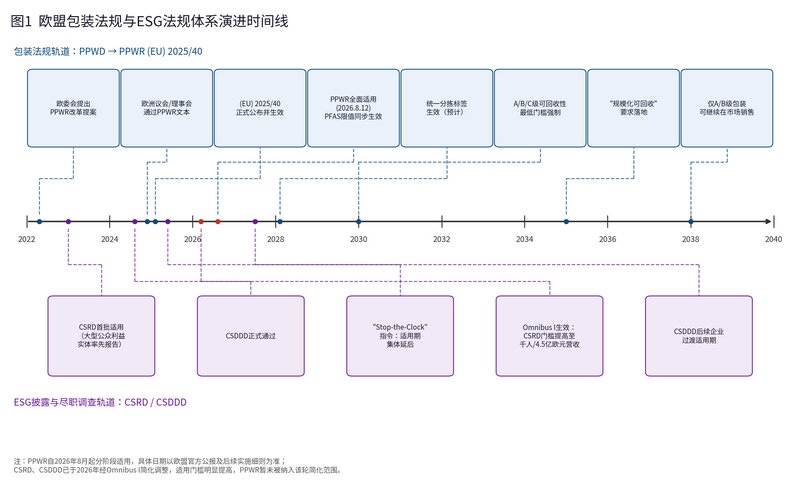
▲Figure Timeline of the Evolution of EU Packaging Regulations and the ESG Regulatory Framework
II. Major Revisions to the PPWR
Compared to the PPWD, the PPWR introduces a series of new specific standards for packaging and packaging waste itself, in addition to changes in regulatory requirements. For Chinese exporters, the four areas that require the highest priority are: restrictions on heavy metals and PFAS in food contact packaging; the mandatory Declaration of Conformity (DoC); the comprehensive mandatory Extended Producer Responsibility (EPR) obligations; and the adjustment mechanism centered on recyclability ratings.
1. Restrictions on Heavy Metals and PFAS
Article 5 of the PPWR continues and harmonizes the restrictions on heavy metals previously set forth in the EU Packaging Directive. The total concentration of the four heavy metals—lead, cadmium, mercury, and hexavalent chromium—in packaging or packaging components must not exceed 100 mg/kg. This limit applies to all types of packaging and will be uniformly enforced starting August 12, 2026, regardless of whether the packaging is intended for food contact. This requirement is not new in itself—most of the previous PPWD and national transposition regulations already contained similar provisions—but the PPWR unifies them under a single threshold, meaning that the more lenient thresholds previously permitted by some Member States will no longer apply. For packaging that uses colored ink printing, metallic coatings, or PVC components—such as garment packaging bags with metal zippers or gift boxes printed with vibrant designs—companies must re-verify that pigment and coating formulations comply with this aggregate limit. While the testing costs for these materials are relatively lower than those for PFAS testing, this step must not be omitted.
Beyond heavy metal restrictions, the PPWR imposes much stricter limits on PFAS in food contact packaging, which is also the focus of the current compliance efforts. The use of per- and polyfluoroalkyl substances (PFAS, commonly known as “forever chemicals”) in food contact packaging is strictly restricted. Section 5(5) of the regulation establishes limit values across three dimensions: any single non-polymeric PFAS substance must be below 25 ppb (micrograms per kilogram); the total of non-polymeric PFAS substances must be below 250 ppb; and the total amount of PFAS—including polymeric PFAS (measured by total fluorine content)—must be below 50 ppm (milligrams per kilogram).
The greatest risk associated with this provision in practice is that it does not provide any transition period for clearing existing inventory. In the official implementation guidelines issued by the European Commission on March 30, 2026, it was clearly stated that, effective August 12, 2026, any food contact packaging newly placed on the EU market must comply with the aforementioned limits; even if such packaging was manufactured prior to that date, it will not be exempt. This means that if a company does not begin searching for alternative materials or arranging for testing until mid-2026, once August 12 arrives, any remaining inventory of old packaging in its warehouses will instantly become non-compliant products, facing the dual losses of mandatory return or destruction.
In terms of testing methods, the EU guidelines provide a step-by-step testing process: First, measure the total fluoride content; if it is below 50 ppm, the sample is considered compliant without the need for further testing; if the level exceeds 50 ppm, the second step involves using methods such as pyrolysis-gas chromatography-mass spectrometry (GC-MS) to distinguish between organic and inorganic fluorine; if organic fluorine levels still exceed the limit, the third step requires the use of the Total Oxidizable Precursors (TOP) analysis method to specifically verify compliance with the two limit values of 25 ppb and 250 ppb. This process itself places significant demands on laboratory capabilities. Coupled with a surge in global testing demand ahead of the implementation of the PPWR, many third-party laboratories already have testing schedules booked months in advance, and the cost of targeted testing for a single PFAS type in a single product can reach several thousand or even tens of thousands of RMB.
For businesses, the shift in the burden of proof is particularly important to note. In the past, a “declaration of conformity” issued by a supplier—even without any test data—was often sufficient for downstream companies to establish a defense against liability; however, regulatory agencies and large retailers are now increasingly requiring test reports issued by independent third-party laboratories, and a written declaration alone is no longer sufficient to demonstrate compliance. For product categories that have historically made extensive use of fluorinated oil- and water-repellent treatments—such as paper-plastic composites and molded pulp (e.g., takeout food containers, baked goods paper bags, and hamburger wrappers)—companies must proactively screen their supply chains, identify alternative materials, and complete testing as early as possible, rather than waiting until peak season stockpiling to discover problems.
2.Mandatory Requirements for the Declaration of Conformity (DoC)
Effective August 12, 2026, each distinct type of packaging entering the EU market must be accompanied by a complete EU Declaration of Conformity and supported by technical documentation containing detailed information such as material composition, weight, and recyclability rating.
It is important to clarify that the CE mark cannot be used to demonstrate that packaging complies with the PPWR requirements—the CE mark pertains to a separate set of product safety directives. Only a specifically issued Declaration of Conformity (DoC) can certify that the packaging meets the sustainability requirements specified in Articles 5 through 12 of the PPWR (substance restrictions, recyclability, percentage of recycled content, compostability, waste reduction, reusability, labeling, etc.). This declaration is not a simple assurance document; it must be supported by a comprehensive set of technical documentation. In the event of a random inspection, companies must provide original materials such as a list of materials, test reports, and design specifications—they cannot simply present a single declaration.
There is also a common misunderstanding regarding the role of the Authorized Representative: While non-EU manufacturers may certainly designate an Authorized Representative within the EU to handle related matters, the regulations explicitly stipulate that the core obligations of compiling technical documentation and conducting compliance assessments cannot be delegated. The primary responsibilities of an Authorized Representative are to maintain the Declaration of Conformity (DoC) and technical documentation and to cooperate with regulatory authorities upon request; they do not assume responsibility for the company’s compliance on its behalf. This means that Chinese companies expanding into the EU must possess their own comprehensive capabilities for data collection and documentation preparation—simply registering with a European agency to obtain a contact address will not resolve their compliance issues.
3. Full Mandatory Implementation of EPR
In the cross-border e-commerce sector, Article 45(4) of the PPWR imposes a clear verification responsibility on online marketplace platforms (such as Amazon, eBay, Zalando, etc.): platforms must verify that each seller holds a valid EPR registration number in every Member State where they intend to sell. This is because the platforms themselves also bear joint and several liability for releasing non-compliant goods. Consequently, if verification fails, the platform’s standard practice is to immediately suspend sales and remove the products from the platform, rather than granting businesses a grace period to rectify the issue.
Looking at past cases, since 2022, Germany’s Packaging Act (VerpackG) has tightened verification requirements for registration in the LUCID system. Since then, a large number of Chinese sellers who failed to provide valid EPR registration numbers in a timely manner have faced mandatory delisting or even complete store suspensions imposed by platforms such as Amazon and AliExpress; platforms like Alibaba International and TEMU have also established similar verification and transaction interruption mechanisms. The German regulatory authority (ZSVR) imposes fines of up to 200,000 euros per instance for failure to participate in the system, and fines of approximately 10,000 euros for failure to submit required data. Once a platform determines that a seller is non-compliant, it may also activate a “withholding and payment on behalf” mechanism, directly deducting the ecosystem fees paid on the seller’s behalf from the seller’s account—and these fees are often significantly higher than the cost of the seller completing the compliance registration independently. These strict platform controls did not arise out of thin air.
Following the full implementation of the PPWR, this strict enforcement approach—which had previously been concentrated in Germany—was essentially replicated and extended to all 27 EU member states. The reality facing companies is that the reporting cycles, data fields, and fee structures of national eco-responsibility organizations—such as CITEO in France, CONAI in Italy, and Ecoembes in Spain—remain inconsistent. While the PPWR establishes a unified baseline requiring “mandatory registration and verification for all,” the specific registration processes and fee calculations must still be handled on a country-by-country basis. For companies distributing products across multiple EU countries, the absence of a unified compliance data management system makes it almost certain that they will run afoul of regulations in a particular country at some point due to a single overdue or missing declaration.
4. Recyclability Classification and the Ecological Modulation Fee Mechanism
The PPWR replaces the previously vague term “recyclable” with a tiered recyclability classification system. Article 6 and Annex II of the regulation stipulate that packaging units are classified into different tiers based on the percentage by weight that can be effectively recycled: Class A for 95% or higher, Class B for 80% or higher, and Class C for 70% or higher; anything below 70% is considered non-recyclable. Specific methods for assessing these categories (including material separation efficiency, collection efficiency, and processing efficiency) will be further refined by the Commission through delegated acts by 2028. Effective January 1, 2030, packaging that falls below the Category C threshold will no longer be permitted on the EU market; effective January 1, 2038, the threshold will be further tightened so that only Category A and B packaging may continue to be sold.
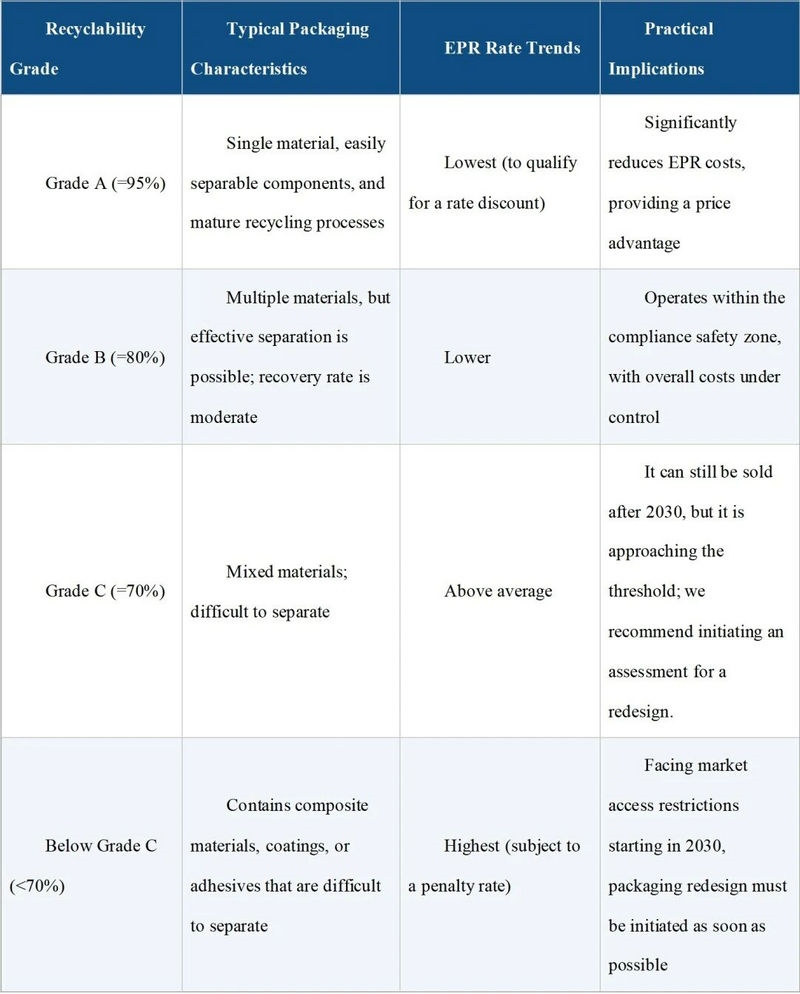
The essence of the grading system is to ensure that the higher the grade, the higher the proportion of recycled materials, and the lower the fee rate; conversely, the lower the grade, the higher the fee rate. The practical effect of this mechanism is that market-driven costs are directly reflected in companies’ packaging design decisions, encouraging them to proactively choose packaging options with higher recyclability grades and lower fee rates.
III. Three Main Methods Used by Chinese Companies to Export Packaging to Europe
Before complying with the PPWR, Chinese companies must first answer a more fundamental question: exactly which role do they play within the PPWR’s responsibility framework? This is not an issue that can be handled vaguely, because Article 3 of the PPWR defines several distinct roles with different responsibilities under the term “economic operator”: Manufacturer, Producer, Importer, and Distributor. Understanding the criteria for determining these four roles is a prerequisite for knowing in which country to register, who should issue the declaration of conformity, and who is responsible for paying EPR fees.
The distinction PPWR makes between “manufacturers” and “producers” is the most easily misunderstood—yet also the most critical—aspect of the entire regulation. According to the legal definition, a manufacturer refers to the entity that places packaging or packaged products on the market under its own name or brand—the determining factor is the name printed on the packaging, not which factory actually produced it. For example, if a Chinese contract manufacturer simply produces cardboard boxes according to the specifications of a European client, and the boxes are printed with the client’s brand, then that factory is merely a “supplier” rather than a manufacturer. Its obligation is to provide material data as requested; the actual manufacturer is the European brand owner. Conversely, if a Chinese brand sells products directly on a cross-border e-commerce platform under its own trademark, that Chinese company is itself the producer. The PPWR’s definition of a “producer,” however, places greater emphasis on the practical role—it refers to the entity that first places the packaging or packaged product on the market within a specific Member State. This could be the producer itself, or it could be an importer or distributor in that country. For the same product, the producer in Germany and the producer in France could very well be two different companies; the regulations do not require them to be the same legal entity, but they do require that “for each Member State and each type of packaging, there must be a single producer clearly identified as responsible for EPR.”
Based on the actual business models of Chinese companies expanding overseas, packaging for exports to Europe can generally be categorized into three typical approaches, each corresponding to different allocations of responsibility.
First, direct sales by brands outside the EU. This is currently the most common model in cross-border e-commerce: Chinese brands or sellers use channels such as Amazon, AliExpress, TikTok Shop, and independent websites to reach European consumers directly under their own brand names, with goods delivered via cross-border logistics or overseas warehouses. Under this model, Chinese companies effectively serve as both manufacturers and producers—they are responsible for packaging design, material composition, and recyclability, must issue declarations of conformity, and must complete EPR registration and fee payments in each Member State where their products are actually sold. As end-distributors, e-commerce platforms bear verification obligations under Article 45(4). Once they discover that a seller’s EPR information is missing or expired, the platform’s default response is to suspend sales rather than issue a reminder to correct the issue. This is why such companies feel the most direct and urgent compliance pressure—the chain of responsibility is short, and when problems arise, it is nearly impossible to shift the burden upstream.
Second, sales through EU importers. A typical scenario is where a Chinese contract manufacturer produces and packages products for a European importer based on an order, and the importer, after purchasing the entire batch, first places the products on the market in a member state under its own name. Under this model, the Chinese factory is typically only the manufacturer or, in some cases, merely a supplier of raw materials or semi-finished products (if the brand does not even belong to the Chinese factory). The EU importer is the party that actually bears the responsibility for production and legal identity, and is required to complete EPR registration and pay fees. However, this does not mean that the Chinese factory is free from any liability: whether the importer can successfully complete the compliance assessment, prove the proportion of recycled content, or provide PFAS test reports depends heavily on the factory’s ability to provide the underlying data in a timely and accurate manner. In practice, it is becoming increasingly common for EU importers to shift this burden of proof back to Chinese suppliers through contractual clauses—if the importer suffers losses at customs or in the market due to missing or falsified data, the costs of claims and returned shipments will ultimately be passed back to the factory.
Third, non-EU sales companies resell products from other brands into the EU. This model is common in multi-tiered trade structures: Chinese factories or traders first sell goods to intermediaries in non-EU regions such as the United Kingdom, Switzerland, and the Middle East; these intermediaries then resell the goods to importers or brand owners within the EU; and after multiple transactions, the goods ultimately enter the EU end market. The risk with this route lies in the fact that the chain of responsibility is stretched very long. Original documentation—such as material test reports, weight data, and recycled content certificates—can easily be lost, tampered with, or become untraceable to their source during multiple transfers. Once EU regulatory authorities or e-commerce platforms initiate a traceability audit for a specific batch, it is often the Chinese suppliers—who are at the very front of the chain yet have the least say—who are the first to be unable to provide a clear account.
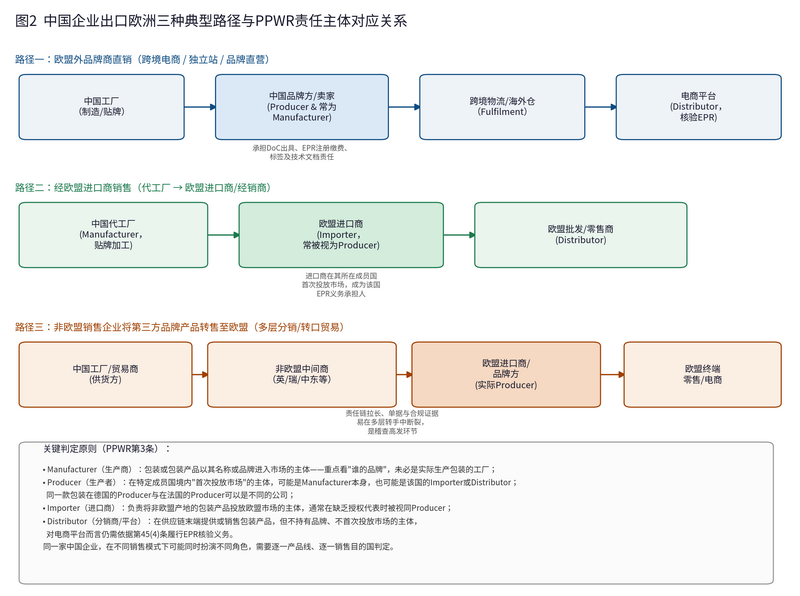
▲Figure Correspondence Between Three Typical Export Pathways for Chinese Companies to Europe and PPWR Responsibility Holders
To more clearly illustrate the division of responsibilities among different parties regarding specific compliance matters, the table below outlines the roles assumed by four parties—Manufacturer (using a contract manufacturer as an example), Producer (using a Chinese seller or brand owner as an example), Importer (EU import agent or Amazon Fulfillment), and Distributor (e-commerce platform or independent website platform)—based on the main compliance dimensions of the PPWR:
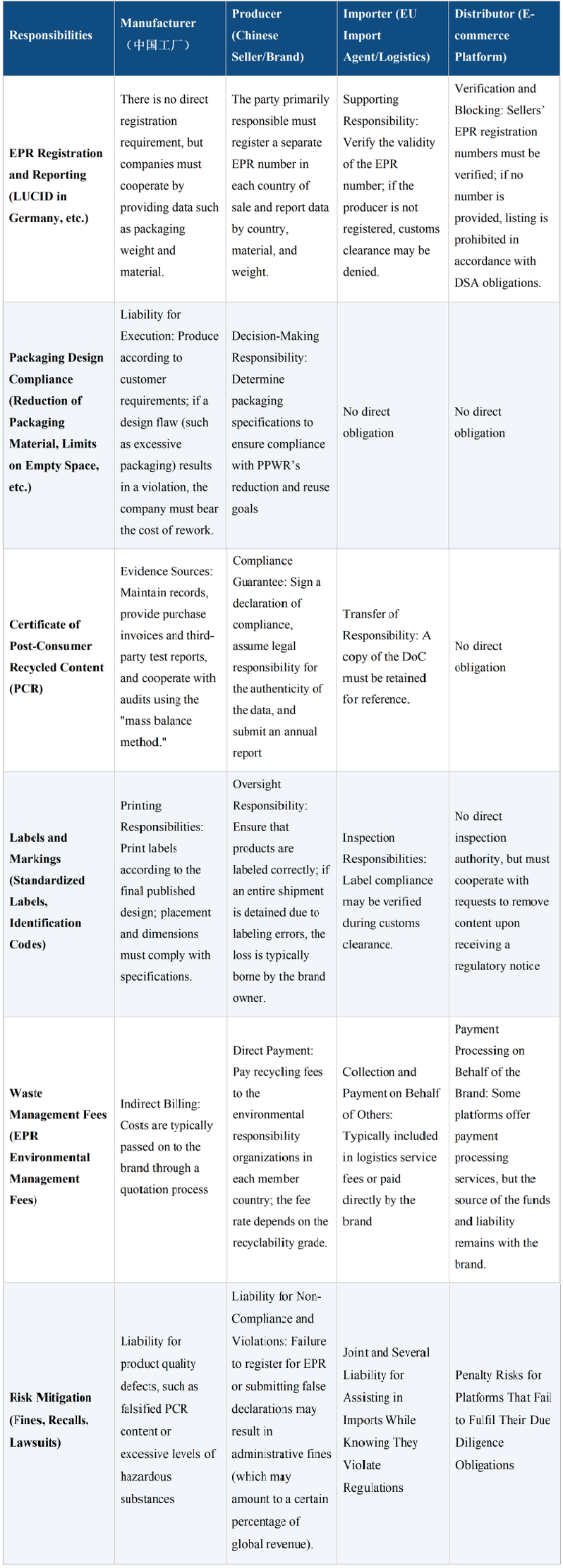
It is important to note that this table provides a simplified summary of the typical division of roles among the four types of entities. In actual business operations, a single company may very well assume multiple roles simultaneously—for example, a Chinese company that has established its own brand and operates a subsidiary in Europe to handle local customs clearance is likely to be both a manufacturer and a producer, while also acting as an importer in specific stages of the process. To determine your true status, you must ultimately refer back to Definition 3 in Article 3 of the PPWR and verify it on a product-by-product and destination-country-by-destination basis; you cannot simply rely on a general industry practice.
IV. Direct Sales by Non-EU Brands: Practical Challenges in E-commerce and Direct-to-Consumer Models
For Chinese companies that primarily expand overseas through cross-border e-commerce and direct sales via independent websites, the impact of PPWR is most immediate and is most likely to result in actual sales disruptions in the short term. The following issues are practical challenges that such companies commonly encounter during their preparations but for which there are no ready-made solutions.
The old packaging has been directly replaced and must now comply with the new packaging requirements. Many sellers’ first reaction is that once PPWR takes effect, they’ll simply need to “switch to a new batch of packaging.” However, the complexity at the operational level lies in the fact that packaging redesign isn’t just a matter of changing materials or printing styles—it requires completing an entirely new set of compliance assessments. Every aspect must be re-evaluated: whether the new material composition meets PFAS limits, whether the new structural design achieves the target recyclability rating, and whether changes in weight affect EPR fee calculations. For sellers in categories with massive inventory volumes (such as home goods and apparel/accessories), this means having to repeat the compliance assessment process for hundreds or even thousands of packaging specifications at once—a workload far exceeding what the phrase “switch to new packaging” might suggest. A practical approach is to first prioritize SKUs based on sales revenue or volume, giving priority to high-volume bestsellers, while ensuring that new product development aligns directly with PPWR standards from the outset to avoid rework later on.
EPR registration and information maintenance must be completed on e-commerce platforms such as Amazon. Common issues include: registration numbers that cannot be found in official databases such as LUCID; failure to sign a contract with a binary recycling system after registration; registration status becoming invalid due to overdue payments; or registration numbers being deemed invalid by the platform’s system because they do not fully match the information on the business license. This underscores that companies should not view obtaining a registration number as the end of the compliance process. Instead, they must establish a regular verification mechanism to ensure that the registration number remains valid in official databases at all times and that the information maintained in the platform’s backend is kept up to date with the latest status.
Who is liable for product damage caused by packaging reduction? The PPWR also sets clear requirements for packaging reduction and void space ratio, but there is a timeline that is easy to confuse: Starting February 12, 2028, sales packaging must comply with the principle of “reducing packaging to the minimum necessary for functionality” and must not use designs such as double-walled structures or false bottoms that make the packaging appear larger; However, the specific quantitative cap on void space—where the void space (including all types of cushioning and filling materials) in group-buying packaging, shipping packaging, and e-commerce packaging must not exceed 50% of the total volume—will not become officially mandatory until January 1, 2030. The specific calculation methods will be clarified in the implementing regulations to be issued by the Commission by February 2028. In other words, the August 2026 deadline itself does not directly trigger a specific percentage threshold for void space. However, the principle-based reduction requirement has already taken effect at an earlier date; waiting until the void space threshold is officially implemented in 2030 to begin modifying packaging designs would be significantly too late. Furthermore, regarding how liability for product damage during transit caused by reduced packaging is allocated among brands, platforms, and consumers, the PPWR itself does not provide a uniform answer. In practice, such issues are primarily handled in accordance with each country’s consumer protection laws and the platforms’ own after-sales policies—in other words, the obligation to comply with packaging regulations does not automatically exempt companies from liability for product quality and transportation safety. Companies must incorporate both reduction and damage prevention into their packaging design simultaneously, rather than simply attributing responsibility to the regulations themselves. A more pragmatic approach is to incorporate practical validation methods—such as drop tests and compression tests—during the packaging redesign phase, using data to make informed decisions rather than relying solely on experience to judge whether the new packaging is adequate.
It’s also worth noting that, effective January 1, 2030, the PPWR will set mandatory reuse rates for specific transport packaging (such as pallets, collapsible plastic crates, returnable containers, and large bulk containers), covering a variety of application scenarios, including e-commerce delivery. At present, this requirement appears to primarily apply to internal corporate logistics and B2B transportation, with relatively limited impact on end-user packaging (such as outer shipping boxes). However, for companies that also operate overseas warehouses and need to shuttle returnable containers and pallets back and forth, assessing the feasibility of a reusable system now will allow for a more relaxed approach than waiting until closer to 2030 to take action.
Are the obligations the same under B2B, B2C, and DTC models? The PPWR does not establish different core compliance standards based on the type of sales channel (B2B, B2C, or DTC); the fundamental principle of the regulation is that “as long as packaging or packaged products are placed on the EU market, they must meet the relevant requirements regardless of who they are sold to.” However, there are differences in the specific implementation details: For B2B transport packaging intended for business customers, scrutiny regarding reduction and void space is typically less stringent than for B2C sales packaging intended directly for consumers; some member states also allow for appropriate adjustments to obligations related to reuse in B2B scenarios; In the DTC model, because brands have direct access to end-user sales data, it is theoretically easier to submit accurate EPR declarations; however, this also means that regulatory authorities and platforms can trace back directly to the brand itself during audits, leaving no intermediary to share the risk.
Does the PPWR provide any exemptions for micro and small enterprises? The answer is: There are very limited exemptions, but they do not cover the majority of Chinese sellers expanding into international markets. The PPWR provides certain relief for “micro-enterprises” (those with fewer than 10 employees and an annual turnover or balance sheet total not exceeding 2 million euros) in certain areas. For example, they are not required to prepare complete technical documentation themselves; instead, their suppliers within the EU may assume this obligation on their behalf. There are also corresponding exemptions regarding certain bans on reusable and single-use packaging. However, it is important to note that this exemption is primarily designed for micro-enterprises registered and established within the EU, and the obligations for EPR registration and fee payment are not covered by the exemption—in other words, no matter how small the business is, as long as it sells packaged products to EU consumers, it must still complete EPR registration in the country of sale. For non-EU companies, the practical scope of this exemption is very limited, and it should not be relied upon as the primary means of avoiding compliance costs.
Does EPR reporting effectively constitute a trade barrier? This is a highly contentious issue within the industry. Those who support this view argue that requiring businesses to register, file declarations, and pay fees separately in each of the 27 member states objectively raises the compliance threshold for small and micro cross-border sellers significantly. For non-EU companies in particular, this imposes additional costs associated with finding an authorized representative and adapting to different data fields across countries, effectively creating a form of hidden non-tariff barrier; Others argue that these requirements apply equally to EU-based companies and do not constitute discriminatory treatment against non-EU firms. They contend that this aligns with the fundamental principle of “equal application to domestic and foreign products” under the WTO Agreement on Technical Barriers to Trade, making it difficult to characterize the system as a discriminatory barrier. Currently, there is a similar debate within the EU itself—for example, France’s long-standing “Triman” domestic recycling label has been deemed by the European Commission to conflict with the PPWR’s goal of a unified label, The European Commission initiated infringement proceedings against France on November 14, 2024, and referred the case to the Court of Justice of the European Union on July 17, 2025—a move that clearly demonstrates the EU’s own efforts to eliminate internal non-tariff barriers. For Chinese companies, rather than dwelling on whether this system is “reasonable,” a more pragmatic strategy is to establish, as early as possible, a data management system capable of covering the declaration fields required by multiple countries, thereby transforming regulatory costs into controllable and budgetable operational costs.
Can each member state independently designate a producer? Could this lead to duplicate registrations? Yes. This is a direct consequence of the “place of first placing on the market” criterion in the PPWR’s definition of “producer”: for the same product, as long as it is sold in different member states, it would theoretically require separate producer designation and EPR registration in each country. Currently, there is no mechanism in place that allows for a single registration in one country to be valid across the entire EU. This represents a significant divergence from the compliance mindset many companies are accustomed to, and it is one of the main reasons why the workload associated with reporting is commonly underestimated. A practical approach is to systematically review the registration status for each country based on the actual list of destination countries for sales, rather than assuming that a single registration document automatically covers other markets.
V. Packaging and the Manufacturing Perspective: Three Cost Pitfalls That Are Easily Overlooked
While the previous sections focused primarily on the perspectives of brands and sellers, for packaging plants and manufacturing facilities responsible for the actual production process, PPWR also hides several cost pitfalls that are easy to overlook but can have significant negative impacts.
The label design may not be the final version. Many manufacturers and trading companies simply view the PPWR label adjustments as a one-time update to the print layout, but the reality is more complicated: The standardized sorting label format required by Article 12 of the PPWR has not yet been officially released by the European Commission; it remains in the drafting process. The official projected effective date is after August 12, 2026, or 24 months after the relevant implementing regulation takes effect. The industry generally expects implementation to occur around 2028. This means that if a factory rushes to print a batch of labels now to meet the August deadline, it will likely have to revise them again once the implementing regulation is officially published in 2028. A more prudent approach at this stage is to prioritize meeting already established basic requirements—such as the Declaration of Conformity and material labeling—while leaving flexibility in the overall visual design of the labels. Companies should closely monitor the progress of the Commission’s implementing regulation to avoid locking in a layout too early that may soon be superseded.
The PPWR explicitly requires that material recovery take precedence over compostable degradation. Article 9 of the PPWR takes a more conservative stance on compostable packaging than many manufacturers of biodegradable materials might expect: the regulation mandates the use of industrially compostable materials only in a very limited number of scenarios—such as breathable tea bags and coffee pouches (including single-serve tea bags and coffee pouches), fruit and vegetable label stickers, and ultra-lightweight plastic shopping bags—that the use of industrial compostable materials is mandatory. Some member states may also decide on their own to include other categories, such as coffee capsules, within the scope of mandatory compostability; however, this falls under the discretion of individual member states and is not a uniform, mandatory requirement at the EU level. Furthermore, even if other packaging uses biodegradable plastics such as PLA, as long as it is not included on this limited list, it must, in principle, be designed for material recycling (rather than compostable degradation). Otherwise, it may actually cause contamination by mixing into the general plastic recycling stream and be deemed non-compliant with recyclability requirements. In other words, under the PPWR framework, the use of biodegradable materials does not automatically guarantee compliance; on the contrary, if the wrong application scenario is chosen, such materials may fail to enter the composting system while simultaneously compromising the purity of the plastic recycling stream.
In terms of specific testing standards, the European Union recognizes EN 13432 as the comprehensive standard for industrially compostable packaging. This standard does not merely measure biodegradation rates; it also includes disintegration testing (at least 90% of the material must be reduced to fragments smaller than 2 millimeters within 12 weeks), ecotoxicity testing, heavy metal content control, and other metrics, constituting a complete certification system. In contrast, the GB/T 19277 standard (or its equivalent, ASTM D6400), which many domestic factories use for routine “biodegradable” testing, is essentially only a standard for testing biodegradation performance. It measures the proportion of material ultimately broken down by microorganisms under controlled composting conditions and does not cover the full suite of criteria required by EN 13432, such as disintegration rate and ecotoxicity. In other words, a GB/T 19277 or ASTM D6400 test report can only prove that a material is biodegradable; it does not automatically equate to compliance with EN 13432 certification, nor can it be directly used as evidence of compliance under the PPWR. If a factory plans to pursue the compostable route, it must additionally verify whether it has obtained the corresponding EN 13432 certification (such as the “OK compost INDUSTRIAL” label), rather than simply presenting existing domestic test reports to European clients.
An increase in PCR content leads to a decline in product quality, yet the PPWR does not provide an exemption for this; instead, it shifts the burden onto companies through the eco-modulation fee. This may explain why many packaging manufacturers frequently raise the following concern in discussions with clients: “We added recycled plastic (PCR) as required, but the material’s strength, transparency, and odor have all been affected. Can we apply for an exemption due to these quality issues?” Based on the text of the regulation, the answer is no. The PPWR does not provide any exemption clauses for product quality deterioration caused by the addition of recycled materials. The logic of the regulation is to apply reverse pressure through the eco-modulation mechanism: the lower the recyclability rating and the further the recycled content falls short of the standard, the higher the EPR fee rate becomes. This uses cost differentials to compel companies to proactively upgrade their designs, rather than relying on a paper exemption to bail out outdated packaging solutions. This is also a key to understanding the overall philosophy of the PPWR: the regulation is not responsible for solving the technical challenge of reconciling material performance with environmental requirements on behalf of companies; it is only responsible for making the cost curve steep enough to force companies to find their own solutions. Whether it involves upgrading the pre-treatment processes for PCR materials or adjusting packaging structural designs to compensate for material performance losses, these are engineering problems that companies must proactively address—not administrative issues that can be circumvented through compliance negotiations.
In terms of the actual magnitude of rate changes, calculations by several European compliance service providers indicate that between 2027 and 2030—as national recycling targets are raised, treatment costs rise, and the eco-modulation mechanism is introduced—the comprehensive EPR rate is expected to increase by approximately 30% to 60%. Furthermore, this increase will vary depending on material type and recyclability grade. The rate differential between single-material, easily separable packaging (such as pure PE or pure PP flexible packaging) and multi-layer composite packaging containing aluminum foil or PVC labels could reach hundreds of euros per metric ton. For food and personal care packaging manufacturers that have long relied on composite films and aluminum-coated layers to achieve moisture-proof and anti-oxidation effects, this represents a hidden cost that must be carefully calculated in advance. A pragmatic approach is to prioritize assessing whether composite structures can be replaced with single-material structures (such as using all-PE co-extruded film instead of PET/PE composite film). While maintaining necessary barrier properties, companies should proactively aim for Grade A or B recyclability. The investment in design modifications should be accounted for by offsetting it against the savings from rising EPR fees over the next few years, rather than passively bearing the costs once the fees have already increased.
Is it possible to use “trade barriers” or countermeasures to counter the relevant requirements of the PPWR? From the perspective of the existing international trade law framework, the practical scope for this approach is quite limited. As an environmental regulation that applies equally to products from both within and outside the EU, the PPWR is difficult to characterize as a discriminatory measure under the WTO Agreement on Technical Barriers to Trade: it does not distinguish based on a product’s country of origin, and EU-based companies are equally required to comply with all provisions, thereby formally adhering to the principle of “national treatment.” If individual countries or companies believe that the design or implementation of certain specific provisions constitutes disguised discrimination (for example, if certain implementing rules objectively favor the EU’s domestic recycling system while being unfriendly to the structure of overseas supply chains), they could theoretically challenge this through the WTO dispute settlement mechanism or bilateral trade consultations. However, this would require presenting concrete, quantifiable evidence of discrimination, and the procedural timeline typically spans years, making it difficult to alter the actual compliance timeline facing companies in the short term. A more realistic approach is to focus efforts on building compliance capabilities rather than hoping to delay the timeline as a whole through legal or diplomatic means—a strategy consistent with the lessons learned by many companies when dealing with other green trade instruments, such as the EU’s Carbon Border Adjustment Mechanism (CBAM).
VI.Implementation of Penalties for PPWR Violations
The penalty framework established by Article 68 of the PPWR.The PPWR does not prescribe uniform fine amounts at the EU level. Instead, it delegates the formulation of penalty rules entirely to the Member States. The key points are as follows: Each Member State must adopt its own penalty rules and notify them to the European Commission by February 12, 2027. Until then, existing penalty provisions under national packaging or environmental legislation are expected to continue to be invoked in dealing with relevant violations. Penalties must be effective, proportionate, and dissuasive. This is standard wording in EU legislation, but the specific amounts, calculation methods, and competent enforcement authorities are left entirely to each Member State. The PPWR itself establishes neither a uniform maximum nor a uniform minimum.
For infringements of Articles 24 to 29, which primarily concern reuse requirements, deposit and return systems, and related matters, the PPWR expressly requires Member States to include administrative fines among the available penalties. In other words, for these infringements, Member States may not rely solely on non-monetary measures such as warnings or corrective orders as a substitute for fines. The terminology below follows the conventions used in the accompanying English guide, including “placed on the market,” “EPR registration,” “Member States,” and “administrative fines.”
Germany: Implementing legislation has already been adopted, providing the most detailed penalty rules to date. Germany is currently the only major Member State to have completed dedicated implementing legislation for the PPWR. The new Packaging Law Implementation Act, abbreviated as VerpackDG, was adopted by the German Bundestag on June 11, 2026, published in the Federal Law Gazette on July 17, 2026, and will enter into force on August 12, 2026, in parallel with the PPWR. It will replace the existing Packaging Act, or VerpackG.
Section 66 of the VerpackDG establishes the following maximum administrative fines:
Placing packaging on the market without registration: up to EUR 100,000.
Operating a recycling system or producer responsibility organization without authorization: up to EUR 200,000.
Failing to comply with mandatory registration or participation obligations, including placing packaging subject to system participation on the market without completing the required participation through a producer responsibility organization: up to EUR 200,000.
Submitting incomplete data or filing declarations after the applicable deadline: up to EUR 100,000.
Two aspects of this framework should be specifically explained. First, as a general principle, the fine must exceed the economic benefit obtained by the undertaking through the infringement. Where the statutory maximum is insufficient to eliminate that benefit, the fine may be increased beyond the stated maximum. This mechanism is based on Section 17(4), sentence 2, of the German Act on Regulatory Offences. Accordingly, EUR 200,000 is not an absolute ceiling. Second, the VerpackDG provides a six-month grace period for newly introduced penalty provisions that directly invoke substantive PPWR obligations, such as sustainability and labeling requirements. These provisions will not take effect until February 12, 2027. However, the grace period applies only to the newly established PPWR-specific penalty provisions. It does not affect fines for registration, authorization, and reporting violations that are already enforced under the existing VerpackG and ZSVR framework. In other words, clients must not interpret this grace period as a general suspension of enforcement in Germany.
France: No PPWR-specific penalties have yet been adopted, and the existing EPR penalty framework continues to apply.France has not yet issued penalty provisions specifically implementing the PPWR. The relevant legislative work remains under coordination among the Directorate-General for Risk Prevention, or DGPR, the French Agency for Ecological Transition, or ADEME, and the Directorate-General for Competition Policy, Consumer Affairs and Fraud Control, or DGCCRF.
Until dedicated rules are adopted, companies should primarily refer to the existing EPR penalty framework under the French Environmental Code:
Article L.541-9-5: Where a producer has not registered with ADEME, has provided incomplete or incorrect registration information, or has failed to display the unique identification number on the relevant materials, the Minister for the Environment may impose a fine of up to EUR 30,000. Where products are placed on the market without registration, an additional fine may be imposed per unit or per tonne of products, up to EUR 1,500 for an individual and EUR 7,500 for a legal entity. The same article also permits the Minister to impose a daily penalty payment of up to EUR 20,000 per day until the infringement has been remedied.
Article L.541-9-4: Failure to comply with information-disclosure obligations, including labeling requirements such as the Triman label, may result in a fine of up to EUR 3,000.
This framework already applies to non-French companies placing packaged products on the French market and was not created specifically for the PPWR. France has also strengthened enforcement against third-party sellers operating through online marketplaces in recent years. Under the Anti-Waste and Circular Economy Law, online platforms are subject to specific verification obligations and may themselves be held liable where they fail to carry out the required checks.
Italy: No PPWR-specific penalties have yet been adopted, and the existing Environmental Code remains relevant.Italy has likewise not yet introduced penalties specifically implementing the PPWR. Under the existing Environmental Code, Legislative Decree No. 152/2006, packaging placed on the market without the required environmental labeling or related information may be subject to an administrative fine ranging from EUR 5,200 to EUR 40,000. These provisions are expected to remain an enforcement basis until dedicated PPWR rules are adopted. Italy’s packaging producer responsibility system continues to be centrally administered by CONAI. Registration, reporting, and fee payments remain subject to the existing CONAI framework. The implementation of the PPWR has not, at this stage, altered that enforcement structure; rather, it adds new sustainability and labeling requirements on top of the existing system.
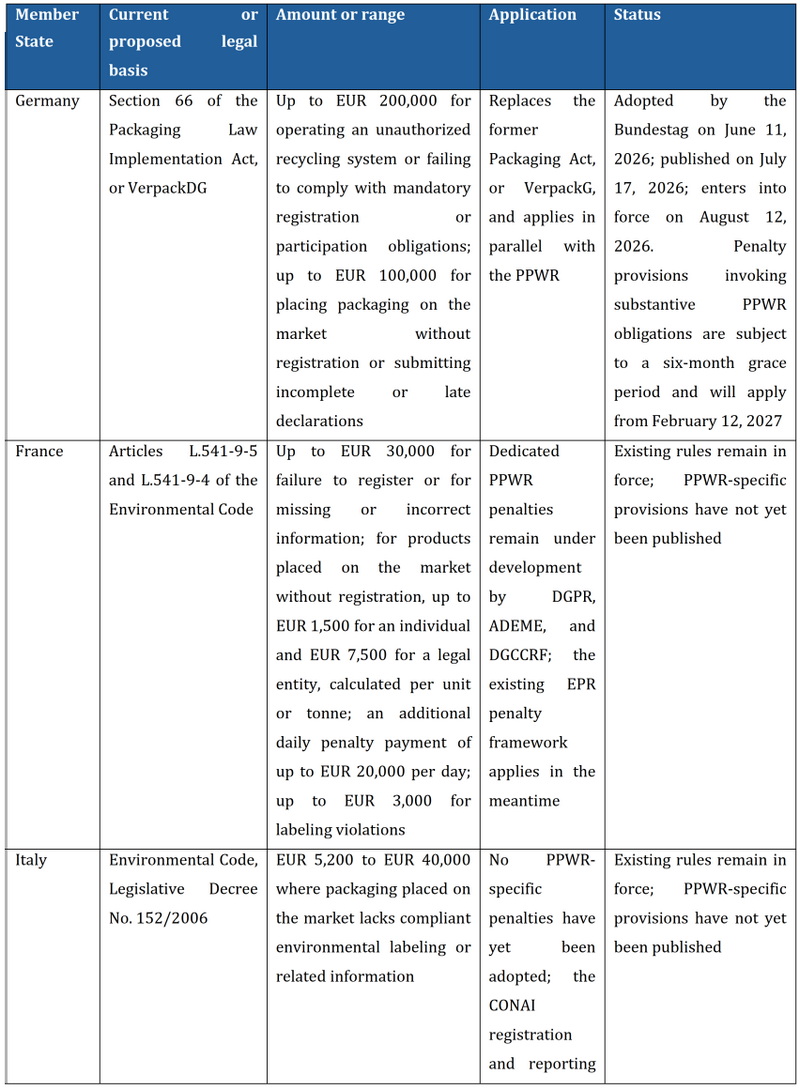
Common enforcement features across the three Member States.A common feature across all three countries is that, regardless of whether their penalty rules have already been specifically updated for the PPWR, failure to complete EPR registration or reporting is generally among the first categories of infringement targeted by enforcement authorities. Applicable fines range from several thousand euros to EUR 200,000 and are commonly accompanied by non-monetary measures such as market-access restrictions, removal of product listings, and confiscation of economic benefits obtained through the infringement.
Because most Member States other than Germany are unlikely to finalize dedicated PPWR penalty provisions until around February 2027, the provisions most likely to be invoked in enforcement proceedings during the interim period will remain those contained in existing national packaging and environmental legislation. These provisions have already been in force for many years, and the penalties they establish are by no means insignificant.
Companies therefore cannot reduce their actual exposure to enforcement merely by postponing compliance preparations on the ground that detailed PPWR-specific penalty rules have not yet been published.
Conclusion: A Few Recommendations for Chinese Companies
The full implementation of the PPWR does not mean that companies can consider the matter settled once and for all after completing registration, testing, or document preparation at a specific point in time. On the contrary, the PPWR is a regulation that will be implemented in phases over time. Standardized labeling, methods for assessing recyclability, recycled plastic content, eco-contribution rates, and certain reuse requirements will continue to be clarified gradually over the coming years through authorizing acts, implementing acts, and supporting regulations issued by member states.
Therefore, what companies truly need to establish is not a checklist of materials intended merely to satisfy short-term inspections, but rather a dynamic compliance mechanism capable of continuously tracking regulatory changes, updating packaging data, and promptly adjusting product solutions. For technical standards and implementation details that have not yet been finalized, companies should continue to monitor developments and allow room for future adjustments; however, regarding PFAS restrictions, declarations of conformity, technical documentation, and EPR obligations that have already been established, companies should not delay further, nor should they use the absence of certain detailed regulations as an excuse to postpone their overall compliance efforts.
At the operational level, companies must first accurately determine their status and responsibilities under the PPWR system based on their product lines, sales models, and target countries. In particular, companies operating in multiple EU member states simultaneously cannot rely on their registration experience in Germany, France, or any single country to fulfill compliance requirements across the entire EU market. Differences still exist among member states regarding EPR registration systems, reporting cycles, data fields, fee schedules, and authorized representative requirements. Companies should maintain country-specific ledgers for registration, reporting, fee payment, and status verification to avoid risks such as product delisting, sales interruptions, or market regulatory issues resulting from expired registration numbers, late reporting, or inconsistent information.
PFAS testing, DoC preparation, and EPR reporting should not be viewed as separate, isolated processes. Test reports serve as a critical foundation for technical documentation, which in turn forms the basis for companies to issue Declarations of Conformity and respond to regulatory spot checks; underlying data—such as packaging materials, weight, and the proportion of recycled content—directly impact EPR reporting and fee calculations in various countries. Companies need to establish a unified packaging data repository as soon as possible and, based on their product types and sales scope, select testing laboratories, compliance service providers, and local EU responsible entities with the appropriate capabilities. This will help avoid discovering—just as sales deadlines approach—that testing schedules, data completeness, or registration timelines cannot meet business needs.
At the same time, PPWR compliance cannot be achieved by a single company acting alone. Although manufacturers, producers, importers, and distributors have different legal obligations, information regarding material composition, packaging weight, test reports, recycled content certificates, label information, and EPR data must be continuously shared across all links in the supply chain. Brands cannot simply issue vague requirements to factories to “comply with EU regulations,” nor can manufacturers use “production in accordance with customer drawings” as a sole basis for exemption from liability. All parties should use procurement contracts, quality agreements, or specific compliance addenda to clearly define who is responsible for providing data, preparing documents, submitting declarations, and verifying information, as well as who bears the responsibility for rework, return shipments, recalls, and compensation in the event of non-compliance.
It is important to emphasize that the consequences of non-compliance with PPWR extend far beyond a mere fine. For companies, the associated risks may manifest directly as the suspension of sales on e-commerce platforms, the inability to enter target markets, delays in customs clearance, product recalls or destruction, customer claims, loss of orders, and damage to brand reputation. For companies that rely on the EU market, a single packaging compliance issue could ultimately affect not just a specific batch of products, but the entire sales channel and customer relationships.
Based on this, Chinese exporters can prioritize the following tasks at this stage: identify the responsible entities for their product lines and target sales countries; arrange testing for PFAS and other restricted substances in high-risk packaging as early as possible; establish templates for declarations of conformity and technical documentation; set up a multi-country EPR registration and ongoing reporting mechanism; incorporate requirements for packaging reduction, recyclability, and recycled content into the product design and procurement phases; and regularly review the authenticity, completeness, and traceability of supplier data and compliance documents.
In the short term, PPWR will undoubtedly increase costs related to testing, registration, material substitution, and internal management. However, from a medium- to long-term perspective, it serves more as a systematic assessment of a company’s supply chain management capabilities and product compliance capabilities. The sooner companies standardize their packaging data, division of responsibilities, and compliance processes, the more they will be able to reduce the costs associated with subsequent repeated corrective actions, emergency product recalls, and inventory write-offs.
For companies hoping to operate in the EU market over the long term, PPWR compliance is no longer an optional task, but rather a prerequisite for entering the market, maintaining sales, and earning customer trust. The sooner a company prepares for compliance, the more control it will have when future regulations become even stricter; continuing to wait and see or taking a reactive approach to compliance may result in costs far exceeding the initial investment in compliance.
Note:
[1]Regulation (EU) 2025/40 of the European Parliament and of the Council of 19 December 2024 on packaging and packaging waste, Article 68 (Penalties). Official Journal of the EU, OJ L 2025/40, 22.1.2025.
[2]EUROPEAN PARLIAMENT, COUNCIL OF THE EUROPEAN UNION. European Parliament and Council Directive 94/62/EC of 20 December 1994 on packaging and packaging waste[Z/OL]. Official Journal of the European Communities, 1994-12-31.
[3]EUROPEAN COMMISSION. Commission Notice—Guidance document for Regulation (EU) 2025/40 on packaging and packaging waste: C(2026) 3702 final[Z/OL]. 2026-06-05.
[4]EUROPEAN COMMISSION, DIRECTORATE-GENERAL FOR ENVIRONMENT. Packaging and Packaging Waste Regulation (PPWR)—Frequently Asked Questions[EB/OL]. 2026-03-30.
[5]EUROPEAN COMMISSION. The European Green Deal: COM(2019) 640 final[Z/OL]. Brussels, 2019-12-11.
[6]EUROPEAN PARLIAMENT, COUNCIL OF THE EUROPEAN UNION. Directive (EU) 2022/2464 of 14 December 2022 as regards corporate sustainability reporting—Corporate Sustainability Reporting Directive, CSRD[Z/OL]. Official Journal of the European Union, 2022-12-16.
[7]EUROPEAN COMMISSION. Commission Delegated Regulation (EU) 2023/2772 of 31 July 2023 supplementing Directive 2013/34/EU as regards sustainability reporting standards—European Sustainability Reporting Standards, ESRS[Z/OL]. Official Journal of the European Union, 2023-12-22.
[8]EUROPEAN PARLIAMENT, COUNCIL OF THE EUROPEAN UNION. Directive (EU) 2026/470 of 24 February 2026 amending certain corporate sustainability reporting and due-diligence requirements[Z/OL]. Official Journal of the European Union, 2026-02-26.
[9]BUNDESREPUBLIK DEUTSCHLAND. Gesetz zur Anpassung des Verpackungsrechts und anderer Rechtsbereiche an die Verordnung (EU) 2025/40 vom 13. Juli 2026: BGBl. 2026 I Nr. 207[Z/OL]. 2026-07-17.
[10]BUNDESREPUBLIK DEUTSCHLAND. Gesetz über das Inverkehrbringen, die Rücknahme und die hochwertige Verwertung von Verpackungen—Verpackungsgesetz, VerpackG[Z/OL]. 2017-07-05.
[11]BUNDESREPUBLIK DEUTSCHLAND. Gesetz über Ordnungswidrigkeiten—OWiG: §17 Höhe der Geldbuße[Z/OL].
[12]RÉPUBLIQUE FRANÇAISE. Code de l’environnement [Z/OL].
[13]EUROPEAN COMMITTEE FOR STANDARDIZATION. EN 13432:2000 Packaging—Requirements for packaging recoverable through composting and biodegradation—Test scheme and evaluation criteria for the final acceptance of packaging[S]. Brussels: CEN, 2000.
[1]Regulation (EU) 2025/40 of the European Parliament and of the Council of 19 December 2024 on packaging and packaging waste, Article 68 (Penalties). Official Journal of the EU, OJ L 2025/40, 22.1.2025.
[2]EUROPEAN PARLIAMENT, COUNCIL OF THE EUROPEAN UNION. European Parliament and Council Directive 94/62/EC of 20 December 1994 on packaging and packaging waste[Z/OL]. Official Journal of the European Communities, 1994-12-31.
[3]EUROPEAN COMMISSION. Commission Notice—Guidance document for Regulation (EU) 2025/40 on packaging and packaging waste: C(2026) 3702 final[Z/OL]. 2026-06-05.
[4]EUROPEAN COMMISSION, DIRECTORATE-GENERAL FOR ENVIRONMENT. Packaging and Packaging Waste Regulation (PPWR)—Frequently Asked Questions[EB/OL]. 2026-03-30.
[5]EUROPEAN COMMISSION. The European Green Deal: COM(2019) 640 final[Z/OL]. Brussels, 2019-12-11.
[6]EUROPEAN PARLIAMENT, COUNCIL OF THE EUROPEAN UNION. Directive (EU) 2022/2464 of 14 December 2022 as regards corporate sustainability reporting—Corporate Sustainability Reporting Directive, CSRD[Z/OL]. Official Journal of the European Union, 2022-12-16.
[7]EUROPEAN COMMISSION. Commission Delegated Regulation (EU) 2023/2772 of 31 July 2023 supplementing Directive 2013/34/EU as regards sustainability reporting standards—European Sustainability Reporting Standards, ESRS[Z/OL]. Official Journal of the European Union, 2023-12-22.
[8]EUROPEAN PARLIAMENT, COUNCIL OF THE EUROPEAN UNION. Directive (EU) 2026/470 of 24 February 2026 amending certain corporate sustainability reporting and due-diligence requirements[Z/OL]. Official Journal of the European Union, 2026-02-26.
[9]BUNDESREPUBLIK DEUTSCHLAND. Gesetz zur Anpassung des Verpackungsrechts und anderer Rechtsbereiche an die Verordnung (EU) 2025/40 vom 13. Juli 2026: BGBl. 2026 I Nr. 207[Z/OL]. 2026-07-17.
[10]BUNDESREPUBLIK DEUTSCHLAND. Gesetz über das Inverkehrbringen, die Rücknahme und die hochwertige Verwertung von Verpackungen—Verpackungsgesetz, VerpackG[Z/OL]. 2017-07-05.
[11]BUNDESREPUBLIK DEUTSCHLAND. Gesetz über Ordnungswidrigkeiten—OWiG: §17 Höhe der Geldbuße[Z/OL].
[12]RÉPUBLIQUE FRANÇAISE. Code de l’environnement [Z/OL].
[13]EUROPEAN COMMITTEE FOR STANDARDIZATION. EN 13432:2000 Packaging—Requirements for packaging recoverable through composting and biodegradation—Test scheme and evaluation criteria for the final acceptance of packaging[S]. Brussels: CEN, 2000.
[14]WORLD TRADE ORGANIZATION. Agreement on Technical Barriers to Trade—TBT Agreement[Z/OL]. Geneva: WTO, 1995.