Cross-Border Enforcement of Civil and Commercial Judgments — France
2026-08-03
Volume 1 of 2 — Fifteen questions
Preamble
As trade and cross-border investment between France and China continue to expand, the recognition and enforcement of civil and commercial judgments between France and the Chinese mainland has become a critical issue that market participants must address at the dispute resolution stage. This is the France instalment of DeHeng Law Offices’ Cross-Border Enforcement Guideline series. In a Q&A format, it systematically maps the recognition and enforcement of civil and commercial judgments between France and the Chinese mainland, with a particular focus on the Sino-French Judicial Assistance Agreement of 4 May 1987, the 2023 PRC Civil Procedure Law, and the relevant doctrinal evolution and judicial practice. It covers civil and commercial judgments only; the arbitral awards instalment will be published separately.
Volume 1 is structured around the questions typically raised by clients. It provides focused answers to 15 questions and sets out the sources, explanatory notes concerning numerical data, and verification status relied upon throughout both volumes. Volume 2 examines in greater depth three issues that often determine the success or failure of cross-border enforcement between France and China, but may readily give rise to misunderstanding if addressed only briefly: service of judicial documents, the limits of the exclusive jurisdiction of the Chinese courts, and the reciprocity-based route. On that basis, it also sets out the corresponding practical recommendations and the stages at which they should be implemented.
Part I — Fifteen questions
(1)Is there a bilateral treaty or reciprocity framework between France and the PRC governing the recognition and enforcement of civil and commercial judgments? What is the impact of the Sino-French Judicial Assistance Agreement of 4 May 1987?
For civil and commercial judgments, the applicable treaty framework between France and the Chinese mainland is the Judicial Assistance Agreement in Civil and Commercial Matters signed in Beijing on 4 May 1987 and in force since 8 February 1988 (hereinafter referred to as “Agreement”). Chapter IV (Articles 19 to 25) establishes a reciprocal recognition and enforcement mechanism, of which Articles 19 to 24 govern judgments. Article 19 covers decisions rendered after the Agreement entered into force and passed in force of chose jugée. Article 23(2) prohibits any review on the merits. Article 22 sets out six exhaustive grounds for refusal: indirect jurisdiction; law applied to the status and capacity of natural persons; absence of finality or enforceability in the State of origin; failure to summon the losing party lawfully; prejudice to the sovereignty, security or public policy of the requested Party; and irreconcilable decisions.
In France, the Agreement has been held to govern the recognition of a Chinese divorce judgment to the exclusion of the ordinary conditions of recognition (Cass. 1st civ., 24 January 2018, no. 16-26.698, quashing a Court of Appeal decision that had recognised the judgment under the ordinary conditions). In the Chinese mainland, there are four publicly reported cases in which French court judgments were recognized pursuant to this Agreement: Guangzhou (2005), Fushun (2017), Jinhua (2017) and the Beijing Fourth Intermediate People’s Court (BFIPC) (2020).
All four cases should be interpreted with caution. Recognition of a judgment does not necessarily mean that the underlying debt will ultimately be recovered. The gap between recognition and actual recovery, as reflected in the publicly available information, warrants particular attention from practitioners. In the BFIPC matter a recognised claim of more than USD 46 million yielded a reported recovery of some USD 27,000. Guangzhou (2005) was an insolvency matter, and Focus B (Vol. 2) explains why it is a narrower precedent than its citation frequency suggests. The reported outcome of the enforcement stage of the other matters is not, on the materials we have been able to consult, established. A more prudent formulation is therefore that securing recognition of a judgment and obtaining actual recovery of the debt are two distinct undertakings, with the latter generally presenting greater difficulty. Creditors should plan for enforcement and recovery from the outset, rather than treating them as merely formal procedures that will follow automatically once the judgment has been recognised (see Recommendation 2, Vol. 2).
The practical significance of the Agreement lies less in what it permits than in what it excludes. Where a case falls within the scope of the Agreement, there is no room for the reciprocity review prescribed by Article 298 of the Civil Procedure Law of the People’s Republic of China (2023 Revision) (hereinafter referred to as “2023 CPL”). In our view, the grounds for refusing recognition and enforcement set out in Article 300 should likewise be inapplicable. In such circumstances, Article 22 of the Agreement should constitute the sole applicable framework for review, to the exclusion of all other provisions. Determining whether a particular application falls within or outside the scope of the Agreement is therefore the first step in any strategy concerning the recognition and enforcement of judgments between China and France, and will often be decisive (see Focus C, Vol. 2).
(2)In the absence of an applicable bilateral treaty, is enforcement nonetheless available for a French judgment in the Chinese mainland, notably under Article 298 of the 2023 Civil Procedure Law and the evolving reciprocity doctrine (de facto, presumed, de jure)?
Because the Agreement already covers the vast majority of civil and commercial judgments, other avenues for recognition and enforcement serve only a supplementary role between France and the Chinese mainland. For a French judgment in a matter outside the Agreement’s scope, Article 298 of the 2023 CPL opens a second route resting either on an applicable treaty or on reciprocity. Chinese doctrine has shifted from de facto reciprocity (proof of a positive precedent) to presumed and then de jure reciprocity (Nanning Statement, 8 June 2017; National Court Work Conference Summary, 31 December 2021), now codified.
Based on the materials currently available, there is no publicly reported case in which a Chinese court has recognised a French judgment on the basis of reciprocity. Rather than viewing this “absence” as a lack of judicial precedent, it is more appropriately understood as an institutional consequence of the Agreement: so long as the subject matter of the dispute falls within the scope of the Agreement, the recognition and enforcement mechanism established thereunder should apply, without any need to resort separately to the principle of reciprocity. Moreover, the treaty-based route is generally more favourable to applicants than the reciprocity-based route. In practice, this point should be understood primarily as a risk warning rather than as presenting a new opportunity. Focus C (Vol. 2) sets out why, and what a creditor should do when the claim falls outside the treaty.
(3)How is the 1958 New York Convention on the Recognition and Enforcement of Foreign Arbitral Awards applied in practice between France and the Chinese mainland? Is there an equivalent framework for judgments, and how does this asymmetry shape the trade-off between arbitration clauses and forum-selection clauses when drafting Sino-French contracts?
The New York Convention governs the recognition and enforcement of foreign arbitral awards. In principle, there is no directly corresponding institutional framework specifically applicable to foreign court judgments. This asymmetry between the two regimes, however, has important implications for the drafting of dispute resolution clauses in cross-border contracts between Chinese and French parties. Both France and China are Contracting States to the New York Convention. Foreign arbitral awards may therefore be recognised and enforced in both jurisdictions under a relatively uniform and predictable set of rules. Court judgments, by contrast, do not benefit from a comparable multilateral treaty regime. Their recognition and enforcement principally depend on the 1987 Sino-French Judicial Assistance Agreement, Article 25 of which, in effect, leaves the recognition and enforcement of arbitral awards to be governed by the New York Convention.
China acceded on 22 January 1987 with two reservations: reciprocity, and commerciality as characterised under Chinese law. France ratified on 26 June 1959 with a reciprocity reservation alone, having withdrawn its commerciality reservation with effect from 27 November 1989. A dispute that is not commercial under Chinese law may therefore fall outside the Convention in China while remaining within it in France.
The asymmetry between the two regimes also explains why, in the practice of drafting cross-border contracts between Chinese and French parties, arbitration clauses are generally preferred over choice-of-court clauses where the resulting decision may ultimately need to be enforced outside the jurisdiction of the chosen court. The parties may agree to arbitration administered by institutions such as the China International Economic and Trade Arbitration Commission (CIETAC), the Shanghai International Economic and Trade Arbitration Commission (SHIAC), the Hong Kong International Arbitration Centre (HKIAC), or the International Court of Arbitration of the International Chamber of Commerce (ICC), and may designate Paris or Singapore as the seat of arbitration. This preference is further supported by two considerations. First, Article 279 of the PRC CPL does not automatically render an arbitration agreement ineffective. The exclusive jurisdiction of the Chinese courts excludes the jurisdiction of foreign courts, but not that of arbitral tribunals (see Focus B, Vol. 2).Second, compared with foreign court judgments, arbitral awards may, to some extent, avoid the risk of being denied recognition and enforcement as a result of defective service of judicial documents. In practice, several French court judgments have failed to obtain recognition in China because of service-related defects(see Focus A, Vol. 2). See Recommendation 1 (Vol. 2).
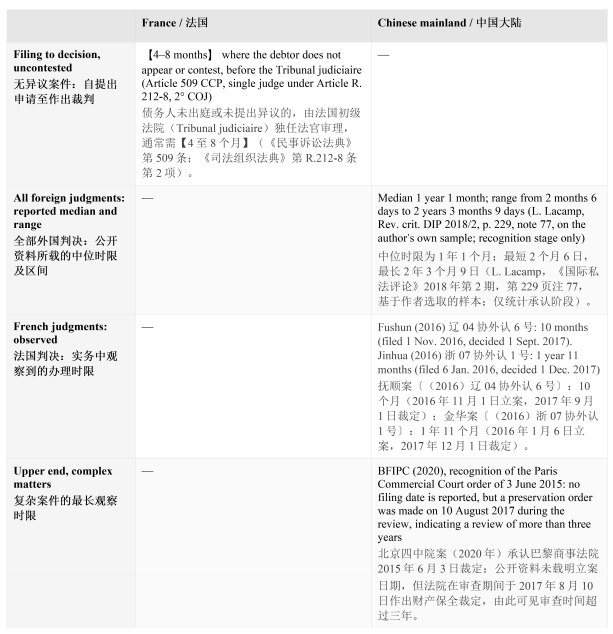
(4)What are the indicative timeframes for obtaining exequatur of a judgment where the proceedings are uncontested by the debtor, in France and the Chinese mainland?
The timeframes below assume uncontested proceedings and full debtor cooperation, which are rare in practice, and exclude international service delays (see question 8). The Chinese figures in the second row are drawn from a single published study of foreign judgments generally, not of French judgments, and are indicative only. Figures shown in 【brackets】 throughout this guide are unverified estimates pending validation; see the note on estimates at the end.
(5)How do these timeframes change if the debtor contests the proceedings, and what avenues of appeal are available against the exequatur decision in each jurisdiction? Does the Chinese internal report-up mechanism to the Supreme People’s Court apply?
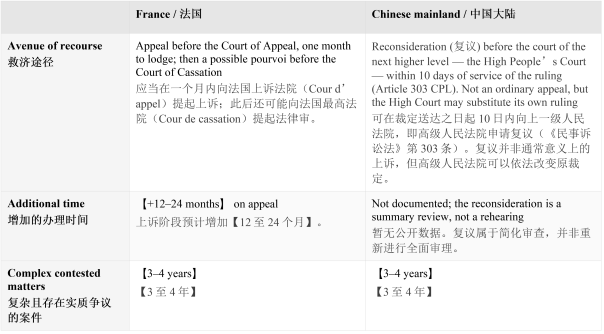
In practice, reference is often made to the reporting mechanism under which cases are submitted through the judicial hierarchy to the Supreme People’s Court. That mechanism, however, does not apply to cases concerning the recognition and enforcement of judgments between France and China. Pursuant to Article 49 of the Minutes of the National Symposium on the Foreign-related Commercial and Maritime Trial Work of Courts (hereinafter referred to as “Minutes”) issued in 2021, the prior-reporting procedure—under which an intermediate people’s court must first submit the case to the relevant higher people’s court for review, following which the higher people’s court submits the case to the Supreme People’s Court for examination—applies only to cases reviewed on the basis of reciprocity. It does not extend to cases governed by an international treaty. The recognition and enforcement of foreign judgments between France and Chinese mainland are governed by the Agreement. Two aspects of this reporting mechanism are also commonly misunderstood. First, the reporting procedure must be completed before the court renders any ruling; it is not triggered only where the court proposes to refuse recognition and enforcement. Accordingly, the procedure applies regardless of whether the proposed outcome is to grant or to refuse recognition and enforcement. Second, the higher people’s court does not merely transmit the case to the Supreme People’s Court. It performs a substantive review and screening function, and will submit the case to the Supreme People’s Court for examination only if it agrees with the intermediate people’s court’s proposed disposition.
What applies to cases involving French judgments is the post-decision filing mechanism provided for in the first paragraph of the same article. Under that mechanism, a people’s court must, within 15 days after rendering its ruling, submit the ruling through each level of the judicial hierarchy to the Supreme People’s Court for filing. This is merely a filing obligation, rather than a procedure for prior approval or authorisation, and it does not provide creditors with any additional procedural safeguard. Accordingly, where a creditor receives an adverse ruling from an intermediate people’s court, its principal avenue of relief is to apply to the relevant higher people’s court for reconsideration. Beyond that, there is no prior-review mechanism before the Supreme People’s Court upon which the creditor may further rely. It should also be noted that the Minutes constitute a judicial policy document rather than a judicial interpretation. They may have binding effect in judicial practice through the courts’ internal hierarchical administration, but may not be cited directly as a legal basis for the reasoning of a judicial decision.
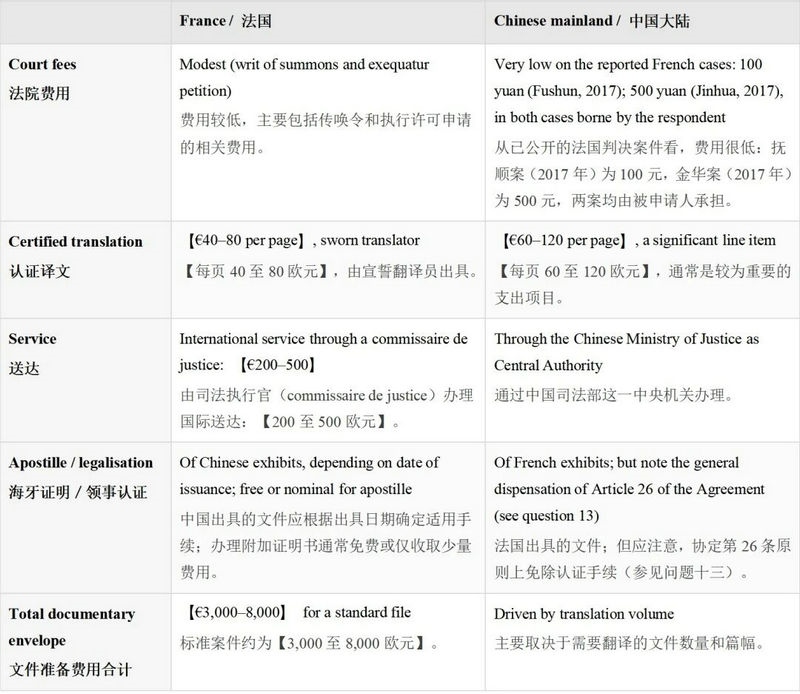
(6)What are the foreseeable costs (court fees, certified translation costs, service and legalisation/apostille costs) for an uncontested exequatur procedure concerning a judgment, in France and the Chinese mainland?
The costs below relate to uncontested proceedings and exclude attorneys’ fees, addressed in question 11.
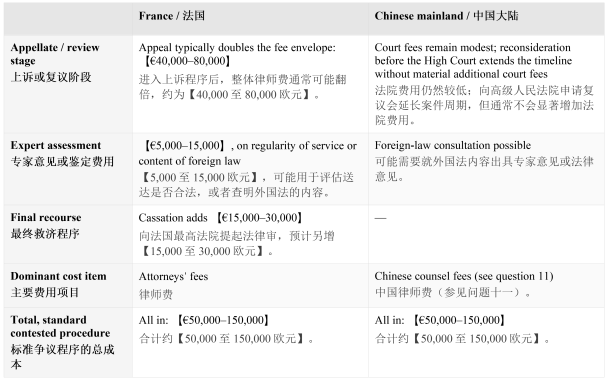
(7)How do these costs evolve in contested proceedings, notably with respect to attorneys’ fees, potential expert costs and appellate costs?
Estimates below assume substantive contestation — public policy, defective service, indirect jurisdiction or irreconcilable decisions grounds — and a debtor represented by local counsel.
(8)What specific difficulties should be anticipated in the Sino-French context, particularly regarding (i) international public policy, (ii) cross-border service of process (1965 Hague Convention, Chinese Central Authority), (iii) exclusive jurisdiction of Chinese courts under Article 279 of the 2023 CPL, and (iv) divergent interpretations across Intermediate People’s Courts?
(i) International public policy. In France, under the standard of review established in Cornelissen, a foreign judgment will not be recognised if it is contrary to French international public policy. This review encompasses both substantive international public policy and procedural international public policy. The latter is principally concerned with whether due process has been observed and whether the parties’ procedural rights have been adequately safeguarded. In China, the ground for refusal set out in Article 22(5) of the Agreement is broader than the public policy exception in its conventional sense. Under that provision, recognition and enforcement may be refused where enforcement of the judgment may prejudice the sovereignty, security or public order of the requested Party. The provision focuses on the consequences that enforcement of the judgment may produce in the requested State, rather than solely on whether the substance of the judgment itself is contrary to public policy. Moreover, the application of the public policy ground by Chinese courts is not necessarily confined to circumstances of exceptional gravity or manifest violations of fundamental legal principles. As illustrated in Focus Issue A of Volume II, courts may also invoke this ground in practice to address issues that, in substance, arise from insufficient supporting documentation or incomplete documentary formalities.
(ii) Cross-border service. China has made a declaration under the Convention on the Service Abroad of Judicial and Extrajudicial Documents in Civil or Commercial Matters (hereinafter referred to as “Convention”) objecting to all methods of service within its territory provided for in Article 10 of the Convention. This objection excludes not only service by postal channels, but also the direct transmission of judicial documents between foreign judicial officers and the direct engagement by an interested person of judicial officers in the requested State to effect service. Accordingly, judicial documents intended for service on a party within China should, in principle, be transmitted through the Central Authority designated by China, namely the Ministry of Justice. According to information published by the Hague Conference on Private International Law, service ordinarily takes approximately [4 to 6 months] to complete. In practice, however, the entire process may take as long as [8 to 12 months]. It should be noted that, although Articles 3 and 5 of the 1987 Sino-French Judicial Assistance Agreement provide that requests for judicial assistance are to be transmitted through the Central Authorities of the two States, they do not expressly identify the authorities concerned. In practice, cross-border service is generally still effected through the Central Authority channel prescribed by the Convention. In cases concerning the recognition and enforcement of judgments between France and China, defects in service constitute one of the grounds most likely to result in a refusal of recognition and enforcement. Such defects may arise in at least three distinct circumstances: see Focus A, Vol. 2.
(iii) Article 279 of the 2023 CPL. A French judgment ruling on the establishment, dissolution or liquidation of a legal person established in China, or on the validity of the resolutions of its organs, trespasses on the exclusive jurisdiction of the Chinese courts and is exposed to refusal. The mechanism by which that refusal operates against a French judgment is not, however, the one most commentaries assume: see Focus B, Vol. 2.
(iv) Divergent interpretations. Based on available materials, intermediate People’s courts apply the Agreement with local nuances. The report-up mechanism does not mitigate this: it does not apply to treaty matters at all (see question 5). The only corrective is reconsideration before the High People’s Court under Article 303 of PRC CPL.
(9)Which categories of decisions are eligible for recognition and enforcement: final judgments, default judgments, interim relief orders, monetary versus injunctive relief, punitive damages?
Eligible for recognition and enforcement are decisions in civil and commercial matters rendered after 8 February 1988 and passed in force of chose jugée (Article 19 of the Agreement), together with judicial conciliations and the civil damages component of criminal judgments.
Default judgments may, in principle, be recognised and enforced, provided that the unsuccessful party was duly served in accordance with the applicable law. Under Article 22(4) of the Agreement, the requested court may refuse recognition and enforcement where the unsuccessful party was not duly summoned and, as a result, did not appear in the proceedings. It is important to distinguish this ground accurately. Two French judgments that Chinese courts have refused to recognise are frequently cited as illustrations of this provision. Strictly speaking, however, neither case was decided directly on the ground that the unsuccessful party had not been duly summoned. In the 2005 Wenzhou case, the central issue was that service by post did not comply with the applicable requirements, with the consequence that the judgment was not regarded as final. In the 2017 Chenzhou case, recognition was refused on the ground that the judgment was contrary to the fundamental principles of Chinese law. Focus A (Vol. 2) examines these three distinct categories of defect separately.
Interim injunctions and other provisional orders lack finality and, based on our interpretation of Article 19 of the Agreement, fall outside its scope in principle. Although the Agreement does not expressly exclude such orders, or expressly exclude any other specific categories of matters, this conclusion may be inferred from the requirement that the decision must have acquired res judicata effect, and is further supported by Article 22(3) of the Agreement. Nevertheless, in late 2020, Beijing No.4 Intermediate People’s Court recognised an order issued by the Paris Commercial Court on 3 June 2015 confirming a settlement agreement. This suggests that Chinese courts may adopt a more flexible approach to the application of the Agreement where the order concerned has a sufficiently definite and enforceable effect.
Judgments ordering the payment of money generally present no particular difficulty in terms of recognition and enforcement. By contrast, injunctive judgments requiring a party to perform, or to refrain from performing, a particular act may encounter considerable practical difficulties in enforcement, as the Chinese enforcement system does not provide a fully corresponding enforcement mechanism. Punitive damages are not a generally applicable remedy under Chinese civil law. Accordingly, the punitive damages component of a foreign judgment may be exposed to the risk of partial refusal of recognition and enforcement. Article 45 of the Minutes sets out an approach under which recognition and enforcement may be partially refused where the amount of punitive damages awarded is manifestly excessive. Based on the materials currently available, however, there remain relatively few publicly reported cases involving punitive damages awarded in French judgments.
(10)What tools are available to identify and locate the debtor’s assets, prior to or in parallel with exequatur proceedings (public registers, asset disclosure orders, Chinese asset preservation, French mesures conservatoires, private investigations)?
France. Before obtaining an exequatur, a creditor may apply to the court on an ex parte basis for authorisation to take conservatory measures, such as the conservatory attachment of the debtor’s bank accounts, receivables that have fallen due, or shares held by the debtor. The debtor’s assets may be traced through commercial registry information, land registry records, lawfully conducted private investigations, and the French national register of bank accounts, known as FICOBA. It should be noted that FICOBA is not a publicly accessible database that may be searched freely. As a general rule, a commissaire de justice is entitled to consult FICOBA only when instructed to enforce an instrument having executory force. Since the relevant legislation entered into force on 22 December 2021, however, a commissaire de justice may also consult FICOBA where a court has issued an order authorising the conservatory attachment of a bank account.
Chinese mainland. A creditor may apply for asset preservation measures to the intermediate people’s court examining the application for recognition and enforcement of the foreign judgment. The proceedings before Beijing No.4 Intermediate People’s Court illustrate this point. That court issued an asset preservation order on 10 August 2017, while the recognition application was still under review and several years before it rendered the recognition ruling in 2020. When applying for asset preservation, the creditor will generally be required to provide reasonably specific and accurate information concerning the debtor’s assets, such as bank account details, the precise addresses of immovable property, and the exact names and registration particulars of companies in which the debtor holds equity interests. In addition to pre-action or pending-action asset preservation, once the judgment has been recognised, enforcement may be pursued through measures including ordering the debtor to disclose its assets, placing the debtor on the List of Dishonest Persons Subject to Enforcement, seizing or freezing equity interests, freezing the cash value of life insurance policies, and using the online enforcement inquiry and control system established by the Supreme People’s Court to identify and freeze bank accounts.
The degree of specificity and accuracy required of information concerning the debtor’s assets is one of the most common obstacles encountered by foreign creditors when applying for asset preservation in China. The timing of any asset investigation should therefore be determined with this requirement in mind: creditors should commence asset investigations at an early stage, rather than wait until an application for asset preservation is to be made before beginning to identify the debtor’s assets (see Recommendation 2 in Volume 2).
(11)How are attorneys’ fees structured (flat fee, hourly rate, success fee, contingency arrangement) for conducting exequatur and enforcement proceedings, taking into account the limits imposed by French professional rules and the All China Lawyers Association (ACLA) regulations?
France. Under Article 10 of Law No. 71-1130 of 31 December 1971 and Article 11.3 of the National Internal Regulations of the French Legal Profession (Règlement Intérieur National, or RIN), a lawyer may not enter into a pure contingency fee arrangement (pacte de quota litis) with a client, under which the lawyer’s remuneration depends entirely on the outcome of the matter. French law does, however, permit the parties to agree on a supplementary success fee linked to the outcome of the matter, provided that a basic fee is also payable. The basic fee may be charged on a fixed-fee or hourly basis. Depending on the size, market positioning and professional experience of the law firm concerned, hourly rates generally range from approximately【EUR 250 to EUR 500】, exclusive of value-added tax. These restrictions apply principally to contentious matters. For non-contentious work, including the recovery of debts through negotiation, legal fees may be calculated solely by reference to the amount successfully recovered. Where recognition and enforcement of a Chinese court judgment are sought in France and the debtor does not contest the application, the total legal fees will generally be approximately 【EUR 15,000 to EUR 40,000】, exclusive of value-added tax. If the proceedings extend to an appeal, the costs will ordinarily increase further.
Chinese mainland. The relevant rules of the All China Lawyers Association permit contingency fee arrangements in certain categories of cases, but impose strict restrictions on both their scope of application and the manner in which fees may be charged. Such restrictions apply in particular to matrimonial and family disputes and to certain matters involving the public interest or issues of public law. In commercial disputes and enforcement proceedings, a commonly adopted fee structure consists of a fixed legal fee supplemented by a contingency fee linked to the outcome of enforcement. Fee levels vary considerably across different regions, and there may be significant differences between major cities such as Beijing, Shanghai and Shenzhen and other cities. For an application before an intermediate people’s court in Chinese mainland for the recognition and enforcement of a French court judgment, the total legal fees will generally be approximately 【EUR 20,000 to EUR 60,000】, exclusive of value-added tax.
The foregoing fee ranges should also be read together with the discussion under Question 15. In China, unless the relevant contract expressly provides that legal fees are to be borne by the party in breach, or there is another legal basis supporting a claim for such fees, the legal fees incurred by the creditor are, in principle, not recoverable from the debtor. Accordingly, these fees will ordinarily constitute an actual cost ultimately borne by the creditor itself (see Recommendation 6, Vol. 2).
(12)What is the limitation period applicable to exequatur actions and enforcement of judgments in France and the Chinese mainland (notably the two-year window under the CPL)? When does time start running, and what are the grounds for suspension or interruption?
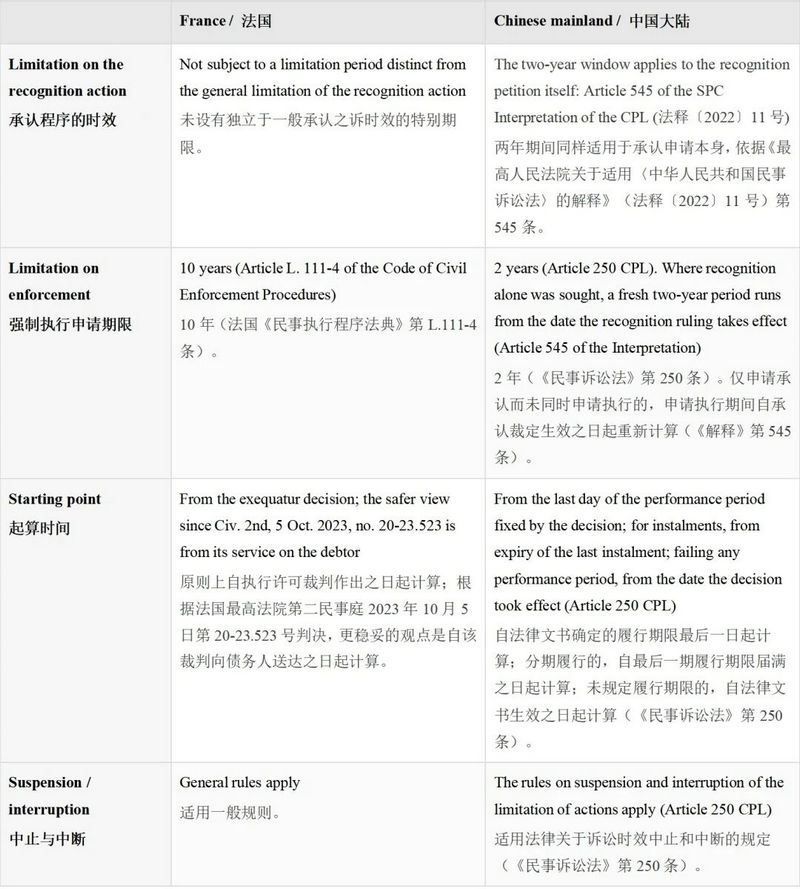
This issue does present a genuine practical risk, but the nature of that risk is often misunderstood. It is now beyond dispute that the two-year period applies to the application for recognition itself. Article 545 of the Interpretation of the Supreme People's Court on the Application of the Civil Procedure Law of the People's Republic of China expressly addresses this point. The real issue requiring the attention of French judgment creditors is the date on which that period begins to run. According to the wording of Article 250 of the PRC CPL, the period commences on the last day of the period for performance specified in the French judgment, rather than upon the occurrence of any procedural event within China.
The time available is limited. Service through the Central Authority alone may take eight to twelve months in practice. Several additional months may then be required to prepare certified translations and the other documents required under Article 21 of the Agreement. A judgment creditor may therefore find that the time limit for applying for recognition and enforcement in Chinese mainland has already expired before the application materials have even been fully prepared, while the judgment may remain enforceable in France for a further nine years. See Recommendation 5 (Vol. 2).
(13)Which documents must be filed with the exequatur court: certified copy of the judgment, certificate of finality, proof of service, certified translation, legalisation or apostille (since the Apostille Convention entered into force for China on 7 November 2023)?
Article 21 of the Agreement sets the documentary baseline for recognition of a French judgment in the Chinese mainland (and vice versa), in three paragraphs:
— Paragraph 1: an expédition of the decision. If it does not state in explicit terms that the decision has passed in force of chose jugée, it must be accompanied by an official act issued by the court attesting that it has. Note what this is not: the certificate attests finality, not enforceability, and it is required only in the alternative.
— Paragraph 2: the original certificate of service of the judgment, or another document having equivalent evidential effect, must be submitted. Failure to satisfy this documentary requirement has directly resulted in the refusal of recognition of a French judgment in China. Article 21(2) requires the applicant, in every case, to submit separate evidence establishing that the judgment itself was duly served. A copy of the summons is additionally required only where the judgment was rendered in default. The application in the 2017 Chenzhou case failed precisely because this distinction was not properly observed: see Focus A, Vol. 2.
— Paragraph 3: certified translations of the exhibits mentioned in the two preceding paragraphs, into the language of the requested forum.
Article 26 of the Agreement provides that all documents covered by the Agreement are exempt from authentication formalities, irrespective of the channel through which they are transmitted. The text of the Agreement expressly states: “No document referred to in this Agreement shall require authentication.” The documents listed in Article 21, which are submitted directly by the parties to the court of the requested Party pursuant to Article 20, plainly fall within the scope of this exemption. For other documents falling outside the scope of the Agreement, two situations must be distinguished following the entry into force of the Convention Abolishing the Requirement of Legalization for Foreign Public Documents for China on 7 November 2023. In principle, documents issued on or after that date are subject to the apostille procedure, whereas documents issued before that date may still require consular legalisation.
(14)What is the general step-by-step procedure for obtaining recognition and enforcement of a French judgment in the PRC (or vice versa), from filing the petition to actual seizure of assets: competent court, nature of the judicial review, available protective measures and enforcement avenues?
France. The exequatur action is brought by writ of summons (assignation) before the Tribunal judiciaire, ordinarily that of the defendant’s domicile under the general rules of Articles 42 et seq. CCP, sitting as a single judge (Article R. 212-8, 2° COJ). Article 509 CCP is the textual seat of enforcement of foreign judgments, but it is a referring provision: it supplies neither the conditions nor the procedure. For a Chinese judgment the conditions are the six grounds of Article 22 of the 1987 Agreement, not the three Cornelissen conditions, which govern only outside any applicable convention — the very point decided on 24 January 2018. Protective measures are available from filing. Once exequatur is granted, enforcement under the Code of Civil Enforcement Procedures (saisie-attribution, saisie-vente, saisie immobilière) is carried out by a commissaire de justice.
Chinese mainland. The applicant must submit a written application to the competent intermediate people’s court, together with the documents required under Article 21 of the Agreement (Article 298 of the PRC CPL). Article 298 does not itself specify the connecting factors for territorial jurisdiction. Jurisdiction is generally determined in accordance with Article 235, under which the application is heard by the intermediate people’s court at the place where the judgment debtor is domiciled or where its assets are located. Where the judgment debtor has neither a domicile nor assets within China, Article 34 of the Minutes provides that jurisdiction may be exercised by the intermediate people’s court at the place where the applicant is domiciled. The court’s examination is confined to the six grounds set out in Article 22 of the Agreement, and the court may not review the merits of the underlying case (Article 23(2)). The applicant may apply for asset preservation from the time the application for recognition is filed. Once the judgment has been recognised, compulsory enforcement may proceed in accordance with Article 247 et seq. of the PRC CPL. Under Article 266, the court may also impose measures on the judgment debtor, including restrictions on departure from China, the recording of non-performance in the credit reporting system, and the publication through the media of information concerning the failure to perform the judgment. The inclusion of the judgment debtor on the List of Dishonest Persons Subject to Enforcement is governed separately by Judicial Interpretation [2013] No. 17, as amended by Judicial Interpretation [2017] No. 7.
(15)Can the creditor recover from the debtor the procedural costs and attorneys’ fees incurred for exequatur and enforcement, and on what basis in each jurisdiction (Article 700 of the French CCP; application fee and enforcement costs in China)?
France. Under Article 700 of the French CCP, the judge orders the losing party to pay the other party a sum, which he determines, in respect of costs incurred and not included in the dépens — principally, though not exclusively, attorneys’ fees. The award is discretionary: the text requires the judge to have regard to equity or to the economic situation of the party ordered to pay, and permits him to decline the award altogether. It is widely observed that awards do not cover the fees actually incurred; the Perben report on the future of the profession (July 2020) recorded this and proposed rewriting Article 700 so that the sum be determined by reference to the amounts actually borne. Recoverable costs (court fees, translation, service) generally fall on the losing party.
Chinese mainland. The court fee payable for an application for the recognition and enforcement of a foreign judgment is, in principle, borne by the judgment debtor once the court has granted recognition. This approach was adopted in both the Fushun case and the Jinhua case. Costs incurred in connection with enforcement measures, including the costs of seizure, valuation and public notices, are also generally borne by the person subject to enforcement. By contrast, legal fees are, in principle, not recoverable from the judgment debtor unless the parties have expressly agreed in advance that such fees are to be borne by the debtor, or specific legislation provides otherwise.
This rule constitutes a notable asymmetry with European practice, and it is one of the few enforcement risks that can be wholly neutralised at the drafting stage: see Recommendation 6.
Note on figures and estimates
Figures shown in 【brackets】 are unverified estimates. They have not been traced to a published tariff, a court schedule, a professional scale or any other external source, and they are pending validation before publication. They should not be relied upon and do not engage the firm. They are retained in this draft only so that reviewers can see what must be checked, and where.
Independently of that, all time and cost estimates assume that the other party fully cooperates with the relevant legal procedures, which rarely happens in practice. Even without opposition, enforcement may face unexpected delays due to changing legislation or bureaucratic hold-ups. Additionally, as litigation in France is adversarial in nature, the actual time and costs of the relevant procedures are in large part determined by the parties’ litigation strategies. It is almost impossible to provide a general but accurate cost/time estimate, and clients should instead seek a case-by-case evaluation.
Note on terminology
Since 1 July 2022, the professions of huissier de justice and commissaire-priseur judiciaire have been merged into a single profession, the commissaire de justice (Ordinance no. 2016-728 of 2 June 2016). The transitional period closed on 1 July 2026, and the title is now exclusive. This guide uses commissaire de justice throughout; "bailiff" and "huissier de justice" are retained only where a source is quoted. Note that the Livre des procédures fiscales still refers to the huissier de justice, the terminological update not having followed the 2016 Ordinance.
Sources
Treaty and conventions
Judicial Assistance Agreement in Civil and Commercial Matters between the PRC and the French Republic, 4 May 1987 — authentic Chinese and French texts: UN Treaty Series, vol. 1514, no. I-26166; Chinese text: Ministry of Foreign Affairs. French decree of publication: décret n° 88-298 of 24 March 1988 (the Agreement itself is not reproduced on Légifrance). · HCCH Service Convention 1965, Chinese declarations: HCCH status table. · Apostille Convention, entry into force for China 7 November 2023: HCCH status table. · New York Convention 1958, reservations of China and France: UN, MTDSG, ch. XXII-1.
Chinese legislation and judicial documents
Civil Procedure Law of the PRC, 2023 revision, consolidated text: Gazette of the Supreme People’s Court; NPC Standing Committee decision of 1 September 2023. · Interpretation of the CPL, 法释〔2022〕11号, art. 545. · Enterprise Bankruptcy Law, art. 5, in force 1 June 2007. · Provisions on the publication of information on the list of dishonest judgment debtors, 法释〔2013〕17号, as amended by 法释〔2017〕7号. · Minutes of the National Court Work Conference on Foreign-Related Commercial and Maritime Trials, 31 December 2021, arts. 33, 34, 44, 45, 46, 49: Supreme People’s Court / CICC. · Nanning Statement of the Second China-ASEAN Justice Forum, 8 June 2017, art. 7.
French legislation and case law
Code de procédure civile, arts. 42 et seq., 509, 700. · Code des procédures civiles d’exécution, art. L. 111-4. · Code de l’organisation judiciaire, art. R. 212-8, 2°. · Livre des procédures fiscales, art. L. 151 A. · Ordonnance n° 2016-728 of 2 June 2016, art. 25. · Loi n° 71-1130 of 31 December 1971, art. 10; RIN, art. 11.3. · Cass. 1st civ., 20 February 2007, no. 05-14.082 (Cornelissen). · Cass. 1st civ., 4 November 2015, no. 14-11.881. · Cass. 1st civ., 24 January 2018, no. 16-26.698. · Cass. 2nd civ., 5 October 2023, no. 20-23.523. · Rapport Perben on the future of the legal profession, July 2020.
Chinese decisions cited
Guangzhou Intermediate People’s Court, 2005, Re Pellis Corium "P.E.L.C.O.R" (docket reported variously as (2005) 穗中法民三初字第46号 and 第146号; ruling not consulted). · Wenzhou Intermediate People’s Court, 13 December 2005, (2005) 温民三初字第155号, Schneider Electric Industries. · Chenzhou Intermediate People’s Court, 20 June 2017, (2016) 湘10协外认1号. · Fushun Intermediate People’s Court, 1 September 2017, (2016) 辽04协外认6号. · Jinhua Intermediate People’s Court, 1 December 2017, (2016) 浙07协外认1号. · Beijing Fourth Intermediate People’s Court, 2020, docket not reported. · Supreme People’s Court reply, 23 December 2010, (2010) 民四他字第81号 (Hukla-Werke). None of these rulings is available in full text; the reported elements are drawn from the secondary sources below.
Secondary sources
China Justice Observer, list of China’s cases on recognition of foreign judgments, and case notes on the Chenzhou, Fushun, Jinhua and Beijing matters. · L. Lacamp, "La circulation des jugements étrangers en Chine : la route de l’exequatur", Rev. crit. DIP 2018/2, p. 229 (median and range of recognition timeframes, note 77). · 张文亮,外国判决承认与执行语境下“送达抗辩”研究,《当代法学》2019年第2期. · 德恒,中法民商事司法文书域外送达问题研究,2021年8月21日. · 汉坤,跨境争议解决系列之二 — 跨境承认与执行程序中的“送达”问题九问. · King & Wood Mallesons, on the scope of art. 300 of the 2023 CPL, 26 January 2024. · 沈红雨、郭载宇,《民事诉讼法》涉外编修改条款之述评与解读,2023年12月. · European Business Organization Law Review (2022) 23:735 (characterisation of the Pellis Corium precedent).
Verification status
The legal propositions, statutory references and case citations in this guide were verified against primary sources in July 2026. The figures shown in 【brackets】 were not, and are pending validation. Two points are expressly left open: whether the refusal grounds of art. 300 of the PRC CPL apply where the Agreement governs, in particular as regards fraud, on which the Agreement is silent (Focus B); and the outcome of the enforcement stage in the reported recognitions of French judgments, on which we have found no source we are able to corroborate.
Note regarding time/cost estimates throughout this questionnaire:
Time/costs estimates are based on the assumption that the other party fully cooperates with the relevant legal procedures, which rarely happens in practice. Even without opposition, enforcement can face unexpected delays due to changing legislation or bureucratic hold-ups. Additionally, as litigation in this jurisdiction is adversarial in nature, when litigation is involved, the actual time and costs of the relevant legal procedures are in large part determined by the parties' litigation strategies. As such, it is almost impossible to provide a general but accurate cost/time estimate, and clients should instead seek a case-by-case evaluation for more specifically accurate estimates.
Disclaimer
This article reflects the personal views of the authors only and does not constitute legal advice on any specific matter. Readers seeking legal advice on the issues addressed herein should consult qualified counsel on a case-by-case basis.