Expansion of Indirect Control Rules Under the EU's New Foreign Investment Review Regulation (2019/452) and Compliance Strategies for Chinese Enterprises in Cross-Border M&A
2026-07-07
For years, the structuring reflex was simple: to invest in Europe, a Chinese group could acquire through a European subsidiary or holding and stay outside national foreign-investment screening. That route is now closing. On 8 June 2026, the Council of the EU gave final approval to a revised FDI Screening Regulation (overhauling Regulation (EU) 2019/452). It makes screening mandatory in all 27 Member States and, most importantly for Chinese investors, extends it to indirect control: an EU acquirer ultimately controlled by a non-EU parent is now caught. The lesson from our previous note still holds, and goes further. In Europe, “not notifiable” does not mean “no risk”, and a European holding no longer makes the problem disappear.
One、What changes, at a glance
Until now, EU law only required Member States to cooperate and share information; whether to screen at all was left to each State. The reform replaces that soft framework with a common, mandatory backbone.
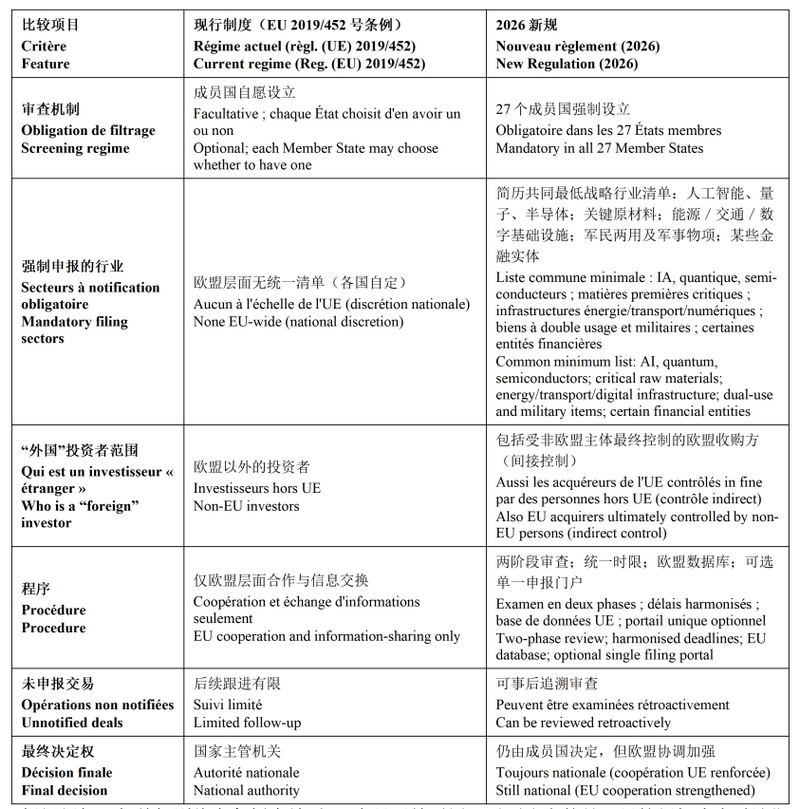
The new rules apply 18 months after the Regulation's entry into force; but national screening regimes already exist in 26 of the 27 Member States, so the screening risk is already here today.
Two、Why it matters for Chinese investors
The EU-holding route is closing. This is the change to focus on. The reform extends screening to indirect control: an EU-based acquirer ultimately owned or controlled by a non-EU (for example, Chinese) parent. Acquiring through a Luxembourg, Dutch or other EU holding will no longer place the deal outside the screening net. The very structure that used to neutralise screening now triggers it.
Mandatory everywhere. There is no longer a “light-touch” or absent regime to route a deal through: all 27 States must screen a common minimum set of strategic sectors (AI, quantum and semiconductors; critical raw materials; energy, transport and digital infrastructure; dual-use and military items; certain financial entities). Many Chinese strategic investments fall squarely within this list.
EN Retroactive review, and still national. Authorities can review unnotified transactions after the fact. At the same time, the decision stays with each national authority (a framework that is harmonised, not uniform); a single pan-EU deal can therefore mean several filings, with local nuances, that must be coordinated.
Three、How to handle a deal going forward
Treat foreign-investment screening as a front to be cleared in every Member State the deal touches, not only the target's home country, and check it early:
1. Map your FDI exposure across each Member State involved (target, assets, subsidiaries), against the new mandatory sector list.
2. Re-examine your structure: an EU holding company no longer shields a non-EU-controlled acquirer; assume indirect control will be assessed.
3. Build in time and standstill: where mandatory screening applies, the deal cannot close before clearance; plan for parallel national filings.
4. Coordinate the layers: FDI screening sits alongside China-side outbound-investment approval (ODI, Decree No. 837) and French and EU merger control; the same multi-layer reflex as in our last note, now with a heavier screening layer.
In practice, engage local counsel in each relevant State plus a China-France team early. Given how tightly these regimes now interact, specialist advice upstream is less a precaution than a condition for getting the deal closed.
Four、Key takeaways
A European subsidiary or holding no longer shields a Chinese acquisition: indirect control is now screened.
FDI screening becomes mandatory in all 27 Member States; strategic sectors must be cleared before closing.
Unnotified deals can be reviewed retroactively; decisions stay national, so one pan-EU deal can mean several filings.
Screening risk is already here: 26 of 27 States have regimes today; harmonised rules apply 18 months after entry into force.
Map FDI and sector exposure across every Member State early, alongside China ODI and merger control.
Sources
[1]Council of the EU : approbation définitive de la refonte du règlement de filtrage des IDE, 8 juin 2026 (révisant le règlement (UE) 2019/452).
Parlement européen (commission INTA) : texte provisoire adopté le 24 février 2026 ; accord politique du 11 décembre 2025.
Règlement (UE) 2019/452 du 19 mars 2019 établissant un cadre pour le filtrage des investissements directs étrangers dans l'Union.
This article is for general information only and does not constitute legal advice.