China’s New Outbound Investment Regulations: Key Updates and Practical Implications
2026-06-30
On 5 May 2026, the State Council promulgated the Regulations on Outbound Investment (State Council Order No. 837, the “New ODI Regulations”), which will take effect on 1 July 2026. The New ODI Regulations represent the first unified administrative regulation issued by the State Council in the field of Chinese outbound investment (“ODI”), which consolidate, at the level of an administrative regulation, the existing ODI framework that had previously been formed primarily through ministerial rules and normative documents, while providing a more systematic interface with national security, export controls, data security, foreign-exchange administration, state-owned asset supervision and counter-sanctions.
In our view, the principal thrust of the New ODI Regulations lies in requiring enterprises to manage cross-border investment compliance in a more systematic and front-loaded manner. We have recently received a number of client inquiries on the implications of the New ODI Regulations for ongoing or planned overseas investment projects. This article provides a preliminary review of the key changes and practical implications of the New ODI Regulations, ahead of their effective date, for reference by enterprises in planning and implementing cross-border investment projects.
I.Background and Regulatory Positioning
Chinese enterprises’ overseas investment has grown significantly in scale and complexity in recent years. The associated regulatory considerations have broadened from the traditional concern over capital outflow to encompass national security, supply chain stability, the export or overseas use of core technologies, cross-border data transfer, overseas evidence production, sanctions conflicts and the continuing management of overseas assets. Prior to the issuance of the New ODI Regulations, these issues were governed by a combination of ministerial rules, special-sector legislation and normative documents.
The New ODI Regulations do not replace the existing ODI regulatory framework. The approval, filing and reporting regimes administered by the National Development and Reform Commission (“NDRC”) under the Administrative Measures for Outbound Investment by Enterprises (NDRC Order No. 11) and by the Ministry of Commerce (“MOFCOM”) under the Administrative Measures on Overseas Investments (MOFCOM Order [2014] No. 3), together with the cross-border capital registration and remittance regime administered by the State Administration of Foreign Exchange (“SAFE”) will continue to apply after 1 July 2026 when the New ODI Regulations take effect.
The three instruments also operate across different regulatory dimensions. NDRC Order No. 11 focuses on an outbound investment project and whether it requires NDRC approval, filing or reporting. MOFCOM Order [2014] No. 3 focuses on a PRC enterprise acquiring interests in an overseas non-financial enterprise and on the related approval, filing, reporting and the issuance of the Outbound Investment Certificate. The New ODI Regulations adopt a broader State-level perspective, covering investors, investment policy, national security, cross-border elements, overseas services and protection, counter-measures and legal liability. The New ODI Regulations therefore consolidate and expand the framework rather than simply replacing the two ministerial rules.
Taken together, the New ODI Regulations integrate what had been a multi-agency and partly dispersed regulatory practice into a high-level comprehensive arrangement with clearer hierarchy and more explicit interconnections.
II.Key Changes Introduced by the New Regulations
1.Strengthened Cross-Regime Coordination
Article 14 provides that where outbound investment activities involve cross-border fund settlement, import and export of goods and technologies, cross-border trade in services, cross-border data flows, exit and entry of personnel, merger control review, export control, cybersecurity supervision, tax administration, state-owned asset supervision, or other related matters, the relevant laws, administrative regulations, and other national rules shall apply.
The practical significance of this provision is that a single ODI transaction may simultaneously trigger multiple regulatory regimes. The sequential approach of completing ODI filings first and then considering export control, data export, merger control or state-owned asset issues is increasingly unreliable. The relevant workstreams should be assessed in parallel at the feasibility and structuring stage.
2.Expansion across Investors, Investment Forms, and Regulatory Scope
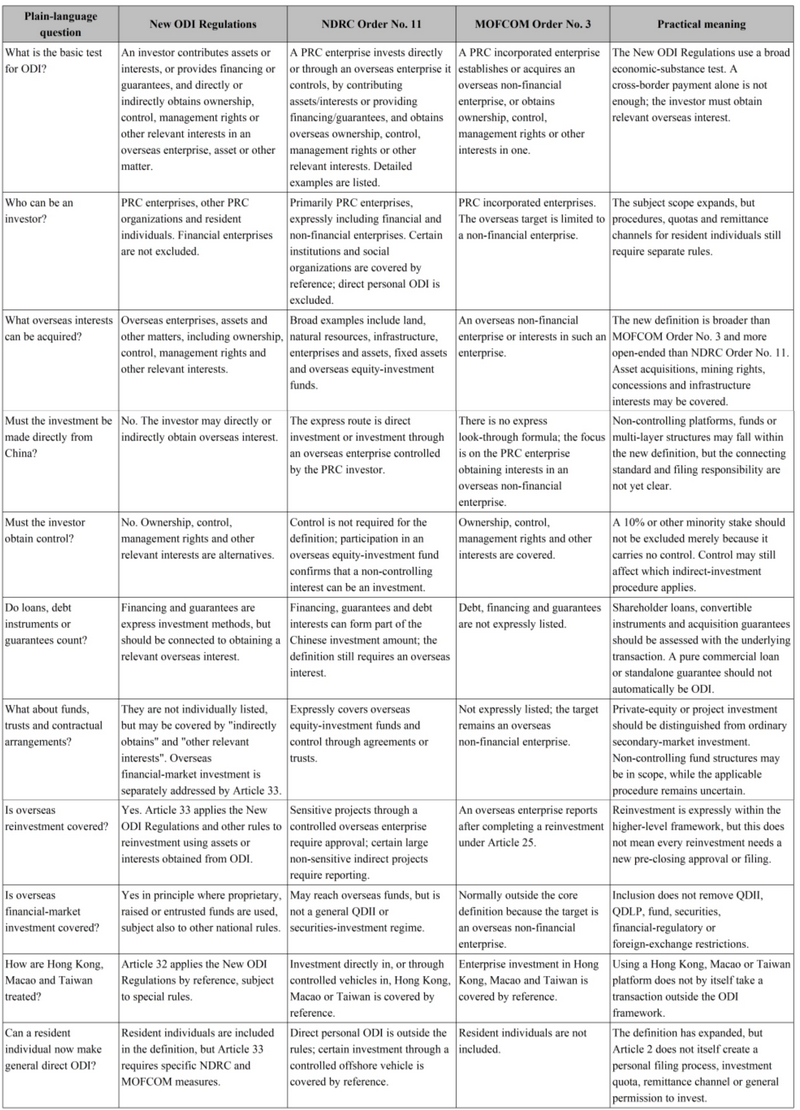
First, the category of investors has been expanded. Article 2 includes PRC enterprises, other PRC organizations, and resident individuals. This is a substantive expansion beyond the enterprise-centered scope of the existing ministerial rules. It does not, however, create an immediate general channel for resident individuals to make direct ODI. Article 33 expressly provides that the specific administrative measures applicable to outbound investment by resident individuals shall be formulated by the competent investment authority and the competent commerce authority under the State Council. Outbound direct investment by individuals, previously administered mainly by SAFE under Hui Fa [2014] No. 37 (“Circular No. 37”), will accordingly fall within the dedicated rules to be issued by NDRC and MOFCOM, the details of which remain to be clarified through subsequent implementing rules. Given that enterprises and individuals are now placed within a single “investor” framework, future supporting rules issued by NDRC and MOFCOM may in principle also apply to individual investors unless expressly excluded.
Second, Article 2 defines ODI by economic substance. It covers an investor that contributes assets or interests, or provides financing or guarantees, and thereby directly or indirectly obtains ownership, control, operational or management rights, or other relevant interests in overseas enterprises, assets or other matters. The reference to direct or indirect acquisition is broader on its face than the formulation in NDRC Order No. 11, which expressly refers to direct investment or investment through an overseas enterprise controlled by the PRC investor. The new wording may therefore reach non-controlling platforms, funds, trusts, contractual arrangements or other multi-layer structures. The connecting test, filing entity and method for aggregating investment amount remain to be clarified.
Third, control is not a necessary element of the definition. Ownership, control, operational or management rights and other relevant interests are expressed as alternatives. A minority stake, fund interest, concession, asset-use right or debt-like instrument may therefore fall within the definition depending on its substance. At the same time, the express inclusion of financing and guarantees does not mean that every arm’s-length loan or standalone guarantee is ODI. The financing or guarantee should be examined together with whether it enables the investor to obtain a relevant overseas interest.
Fourth, overseas financial market investment has been brought within the regulatory scope. Article 33 provides that the New ODI Regulations apply to (i) reinvestment overseas by investors using assets or interests obtained from outbound investment, and (ii) investment in overseas financial markets through proprietary funds, raised funds, or other entrusted funds. This may have systemic implications for various scenarios, including horizontal or vertical business extension by industrial groups through overseas platforms, reinvestment by multinational enterprises using overseas profits and overseas securities investment by listed companies and financial institutions. However, this does not mean that every overseas reinvestment must obtain the new pre-closing ODI filings, or that QDII, QDLP, securities, fund, financial-sector and foreign-exchange restrictions have been relaxed. The New ODI Regulations preserve the application of other relevant national rules.
The comparison below is framed as a series of practical questions so that readers without a prior ODI background can distinguish the statutory definition from the procedures that may apply to a particular transaction.
3.Policy Classification Is Separate from the Sensitive/Non-Sensitive Project Procedures
Article 11 establishes three policy categories: the State encourages certain outbound investments, restricts certain outbound investments and prohibits certain outbound investments. Article 12 separately provides that investors shall, where required by law, complete approval or filing, information reporting and cross-border capital registration. The policy classification and the existing sensitive/non-sensitive project classification serve different functions.
Under NDRC Order No. 11 and MOFCOM Order No. 3, sensitive projects are generally subject to approval, while non-sensitive projects are generally subject to filing or, for certain indirect investments, reporting. By contrast, the encouraged/restricted/prohibited categories express the State’s substantive policy toward an investment. A restricted investment is not automatically a sensitive project, and a sensitive project is not automatically a restricted investment. Nor does Article 11 by itself establish that every restricted project must be approved.
For each proposed transaction, investors should conduct at least three separate screens:
• whether the transaction falls within the broad statutory definition of ODI;
• whether it is encouraged, restricted or prohibited as a matter of national policy; and
• whether it is sensitive or non-sensitive for current NDRC/MOFCOM approval, filing and reporting purposes, together with any national-security or sector-specific review.
Future catalogues or implementing measures may establish links between these classifications, but no direct one-to-one equivalence should be assumed without an express legal basis.
4.Introduction of an Outbound National Security Review
Article 15 provides that the State shall improve the national security review system for outbound investment. NDRC and MOFCOM, together with other relevant State Council departments, shall review outbound investments, and transfers or disposals of related assets and interests, that affect or may affect national security.
This is the first time that a national security review system specific to outbound investment has been established at the level of an administrative regulation. It should not be confused with China's existing foreign investment national security review, which concerns foreign investment into China. The outbound review concerns PRC investors going abroad and may extend to a later transfer or disposal of overseas assets or interests.
The express inclusion of transfers and disposals means that national-security analysis is not limited to entry into an investment. A subsequent sale of an overseas subsidiary, transfer of strategic production capacity, disposal of technology-bearing assets or change of control over an overseas platform may also require assessment. Implementing rules have not yet established the filing threshold, initiation mechanism, review timetable, treatment of completed transactions or available remedies. Enterprises should therefore identify security-sensitive features early and allocate timing and remedy risks in the transaction documents.
5.Compliance Boundaries on Cross-Border Outflows
Article 13 specifically governs cross-border outflows in the context of ODI. An investor must not export, use or transfer goods, technologies, services or related data whose export or overseas use is prohibited by the State, and must obtain the required permission for items whose export or overseas use is restricted. The provision expressly addresses transfers implemented through cross-border secondment of technical personnel, dispatch of personnel to work abroad, cross-border technical guidance and cross-border personnel training.
Read together with Article 14’s provisions, the compliance perimeter covers at least three categories:
(i) goods and technologies, including dual-use items, sensitive technology, source code, drawings, process parameters and technical documentation;
(ii) personnel and services, including secondment, on-site technical guidance, overseas training, remote operation and maintenance, and access to domestic systems; and
(iii) data and access rights, including personal information, important data, operational data, risk-control models and remote access, which may trigger data-export security assessment, standard-contract, certification or other requirements.
The practical consequence is that ODI review must address both the form of the investment and the substance of what will cross the border. A transaction should not be treated as low risk merely because the purchase price does not expressly allocate value to technology or data. Due-diligence disclosure, transitional services, licensing, R&D cooperation, employee secondment and training may independently create regulated cross-border transfers.
A related but distinct issue arises under Article 22, which addresses evidence and materials provided in overseas arbitration, litigation, judicial proceedings or law-enforcement investigations. The relevant scenarios may include foreign merger-control and antitrust reviews, securities and export-control investigations, tax inquiries, sanctions and internal compliance investigations, document production, electronic discovery and expert evidence.
Article 22 should not be read as creating a single new approval requirement for every transmission of evidence. Rather, it makes the existing requirements concerning State secrets, work secrets, data security, personal information, technology export, export controls and international judicial assistance an express ODI compliance checkpoint. The applicable route depends on the material, recipient, proceeding and legal basis for transfer.
A practical evidence-transfer protocol should include:
• classification of the requested material and identification of personal information, important data, technical information, State secrets and controlled items;
• verification of the overseas recipient, formal proceeding, legal basis and proposed transfer route;
• assessment of any required PRC approval, data-export procedure, judicial-assistance channel or technology/export-control license;
• data minimization, redaction, anonymization, access control and secure transfer; and
• an audit trail of the decision, approvals and materials actually supplied.
Transaction and cooperation clauses should therefore avoid an unconditional obligation to provide all PRC documents immediately. They should permit withholding, redaction, delayed production or use of an official cooperation channel where required by PRC law.
6.Strengthened Liability and Enforcement Mechanisms
Articles 27 through 30 establish a more systematic liability regime and materially increase the cost of non-compliance. Compared with the existing ministerial rules, which rely heavily on warnings, rectification, certificate consequences and credit measures, the New ODI Regulations introduce confiscation of illegal gains, fines calculated by reference to investment amount, personal fines, orders to stop an investment or dispose of shares or assets, and temporary restrictions on future ODI.
The table below distinguishes the principal categories of conduct. Percentage-based fines are particularly significant for large acquisitions and infrastructure projects because the statutory exposure scales with investment amount rather than being limited to a fixed monetary ceiling.
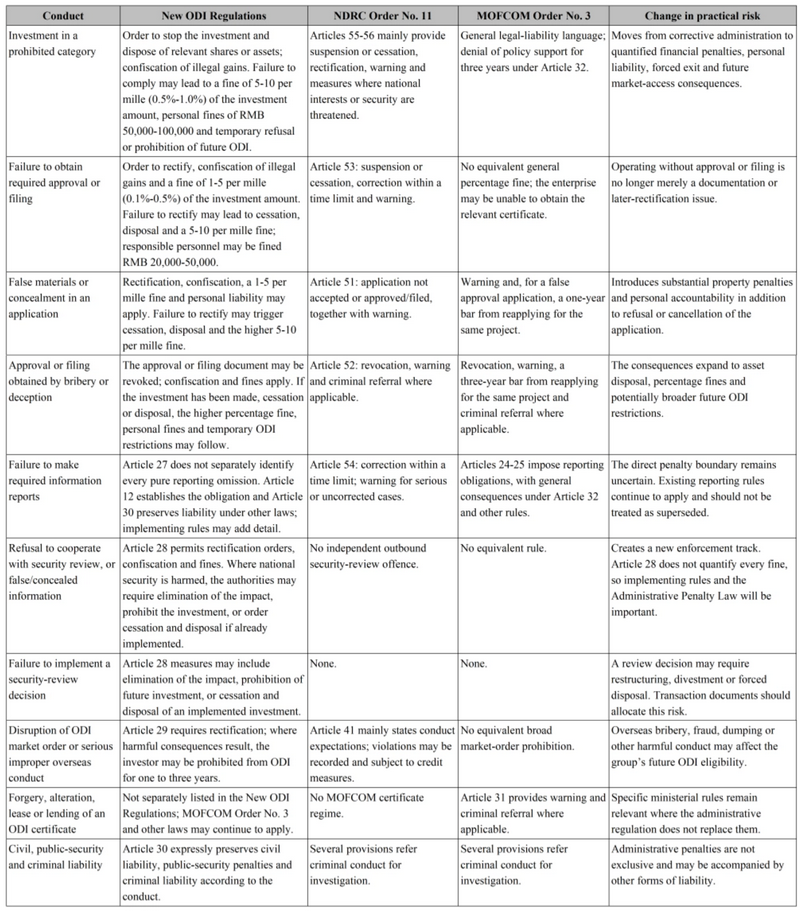
The remedies also affect transaction certainty. An order to stop an investment or dispose of shares or assets may cause forced-sale losses, financing defaults and breaches of overseas transaction documents. Personal liability also makes internal attribution important: boards and management should identify who owns the commercial decision, who verifies the application facts, who signs filings and who monitors post-closing obligations.
III.Practical Implications for Foreign Companies Partnering with Chinese Investors
The New ODI Regulations are addressed principally to Chinese investors and the relevant PRC authorities, but their commercial effects will often be felt directly by foreign joint-venture partners, sellers, project owners, technology licensors, lenders and other counterparties. A foreign company should not treat Chinese ODI compliance as an internal matter for its Chinese partner. Delays, restrictions or adverse decisions on the Chinese side may affect funding certainty, signing and closing timetables, technology and data access, governance arrangements and the viability of the cooperation itself.
The points below are therefore framed from the perspective of a foreign company that is establishing a joint venture with a Chinese investor, selling an interest or asset to a Chinese investor, or cooperating with a Chinese investor on an overseas project.
1.Confirm the Chinese Partner’s Regulatory Path at an Early Stage
Before granting exclusivity, committing significant management time or agreeing a firm closing date, the foreign company should obtain a reasonably detailed Chinese-side regulatory roadmap. The relevant questions extend beyond whether the project is generally described as an ODI project. They include the identity of the actual PRC investor, its ownership and regulatory status, the investment route, the funding and guarantee structure, and the assets, technology, data and personnel that will move across borders.
In particular, the foreign company should seek clarity on:
• the direct investor and its ultimate controller, including whether the investor is a central or local state-owned enterprise, a financial institution, a listed company, a fund, another organization or a resident individual;
• whether the investment will be made directly from China or through an existing offshore vehicle, and whether that offshore vehicle is controlled by the PRC investor;
• the proposed equity, asset, debt, financing and guarantee components, including the source and timing of funds;
• the separate conclusions on (i) whether the transaction falls within the statutory definition of ODI, (ii) whether it is encouraged, restricted or prohibited as a matter of national policy, and (iii) whether it is sensitive or non-sensitive for current NDRC and MOFCOM procedural purposes;
• whether NDRC approval or filing, MOFCOM approval or filing, SAFE registration, state-owned asset approval, financial-sector approval, merger control, national security review, export-control or data-transfer procedures may apply; and
• the expected sequence, responsible authority, supporting documents and realistic timetable for each required step.
For material transactions, the Chinese partner should be asked to provide a responsibility matrix and timetable prepared with its PRC counsel and, where relevant, its bank and state-owned asset or industry regulator. The foreign company does not need to take responsibility for obtaining the Chinese approvals, but it should have sufficient visibility to assess execution risk and to test whether the proposed timetable is credible.
2.Reflect Chinese Regulatory Conditions in the Commercial Timetable and Transaction Documents
Chinese ODI approvals, filings and foreign-exchange registration should be translated into specific contractual mechanics rather than addressed through a generic “all necessary approvals” condition. The documents should distinguish between submission of an application, acceptance by an authority, issuance of an approval or filing notice, completion of foreign-exchange registration, and the actual ability to remit funds. Receipt of an NDRC or MOFCOM document does not by itself guarantee that the purchase price or capital contribution can immediately be transferred out of China.
Depending on the transaction, the foreign company should consider:
• precisely drafted conditions precedent identifying the required PRC approvals, filings, reports and registrations, while allowing additional mandatory procedures arising from implementing rules or a competent authority's written requirement;
• a regulatory cooperation clause requiring each party to provide accurate supporting information, respond promptly to authority questions and notify the other party of material developments, without requiring disclosure that would breach PRC law or legal privilege;
• a realistic long-stop date, extension mechanism and milestone schedule that reflect the possibility of authority enquiries, national security review, state-owned asset procedures and bank review;
• clear allocation of the risk of delay or failure, including treatment of deposits, exclusivity, reverse break fees, transaction expenses and termination rights;
• staged signing, staged closing or phased capital contributions where part of the project can proceed before all funding is remitted, provided this is legally and commercially workable;
• for joint ventures, fallback arrangements if the Chinese partner cannot make its capital contribution on time, including dilution, suspension of voting rights, alternative financing, cure periods and termination or buy-out mechanisms; and
• a change-in-law or regulatory-change clause addressing new implementing rules under the New ODI Regulations and any resulting restructuring, additional filings or timetable changes.
A foreign seller or project owner should be cautious about accepting an unconditional funding commitment from an offshore special-purpose vehicle with limited assets unless the support arrangements have been tested against PRC ODI, guarantee and foreign-exchange rules. Parent guarantees, equity commitment letters, escrow arrangements and reverse break fees may improve commercial certainty, but they should not be structured on the assumption that a PRC parent can always remit funds or honour an offshore guarantee without additional regulatory steps.
The same considerations apply to long-term project cooperation. Where the Chinese party is expected to contribute equipment, technology, personnel, financing or guarantees over several years, the cooperation agreement should identify which obligations depend on PRC regulatory approvals and which are unconditional. This avoids a situation in which the entire project is delayed because one cross-border component cannot lawfully be performed in the originally contemplated form.
3.Manage Technology, Data, Personnel and Evidence Transfers as Separate Compliance Workstreams
Foreign companies should not assume that the Chinese partner’s ODI approval or filing also authorizes the transfer of technology, data, services or personnel. Articles 13 and 14 require those elements to be assessed under their own regulatory regimes. This is relevant not only at closing, but from the earliest due diligence and negotiation stages.
Typical risk points in a joint venture or project cooperation include:
• access by the foreign party or its advisers to a China-hosted data room containing personal information, operational data, technical drawings, source code, process parameters or other sensitive materials;
• technology licenses, intellectual property assignments, technical service agreements and transitional service arrangements that require continuing transfer of know-how or system access from China;
• secondment of Chinese engineers and managers, overseas installation and commissioning, on-site technical guidance, remote maintenance, cross-border training and access to PRC-based information systems;
• joint research and development, model training, cybersecurity access, cloud services and cross-border sharing of production, customer or risk-control data; and
• requests for PRC documents or electronic records in overseas arbitration, litigation, regulatory investigations, audit, compliance reviews or discovery.
For a joint venture, the compliance design should also be reflected in its operational architecture. The parties may need to separate PRC and overseas databases, limit administrator rights, use clean teams, ring-fence source code or controlled technology, and specify which entity employs or supervises seconded personnel. These operational measures are often more effective than relying solely on broad representations that each party will comply with applicable law.
4.Allocate National Security, Enforcement, Counter-Sanctions and Exit Risks
Article 15 extends national security review beyond the initial investment to transfers or disposals of related assets and interests. A foreign partner should therefore consider not only whether the Chinese investment can be made, but also whether a future change of control, transfer of joint-venture shares, disposal of strategic assets, technology migration or termination of the cooperation could require Chinese-side review or remedial action.
The transaction documents should address the possibility that an authority orders the investment to stop, requires mitigation, or directs the disposal of shares or assets. Depending on the parties’ bargaining position and the project, relevant provisions may include regulatory-divestment procedures, permitted transferees, valuation principles, rights of first offer or refusal, put or call options, temporary suspension of governance rights, alternative performance, and allocation of losses arising from a forced or accelerated exit. These provisions should be coordinated with local law restrictions in the jurisdiction of the joint venture or project.
Finally, the foreign company should require continuing compliance monitoring rather than treating Chinese regulatory clearance as a one-off closing item. Joint-venture governance and project reporting should include notice of regulatory enquiries, changes in the Chinese investor's ownership or funding route, proposed transfers or reinvestments, material changes to technology and data flows, and developments under future NDRC, MOFCOM, SAFE or national security review rules.
Overall, a foreign company partnering with a Chinese investor should integrate Chinese ODI risk into its commercial diligence, transaction timetable, contractual protections and post-closing governance. The objective is not to transfer all Chinese regulatory risk to the foreign party, but to ensure that the cooperation remains executable if the Chinese investor must obtain additional approvals, adjust its funding route, restrict a cross-border transfer, accept mitigation measures or exit the investment in response to a binding regulatory decision.
Authors: